|
Illegal Jewish Squatters set fire to Palestinian land in Madama village, southeast of Nablus |
Israeli Occupation Forces (IOF) Continue Systematic Attacks against Palestinian Civilians and Property in the Occupied Palestinian Territory (OPT)
IOF use force to disperse peaceful protest organized by Palestinian civilians in the West Bank.
8 demonstrators, including two children, were wounded.
A Palestinian civilian was wounded by IOF in the central Gaza Strip.
IOF conducted 50 incursions into Palestinian communities in the West Bank and two limited ones into the Gaza Strip.
IOF arrested 13 Palestinian civilians, including 5 children in the West Bank.
IOF summoned 12 Palestinian civilians for interrogation.
Two dunumsof agricultural land in the central Gaza Strip were burnt by Israeli gunfire.
IOF continued to attack Palestinian fishermen in the Gaza Strip.
IOF arrested 5 Palestinian fishermen and confiscated two fishing boats.
Israel has continued to impose a total closure on the OPT and has isolated the Gaza Strip from the outside world.
IOF arrested a Palestinian civilians at a checkpoint in the West Bank.
IOF have continued efforts to create a Jewish demographic majority in East Jerusalem.
Funds were allocated for a new Israeli tourist settlement project in Silwan village in Jerusalem.
IOF destroyed some civilian facilities in Hazma village, northeast of Jerusalem.
IOF have continued settlement activities in the West Bank and Israeli settlers have continued to attack Palestinian civilians and property.
IOF razed 30 dunums of agricultural land in al-Baq’a area, east of Hebron.
A Palestinian civilian was seriously wounded by Israeli settlers.
Israeli settlers set fire to cultivated areas in the south of Nablus.
Summary
Israeli violations of international law and humanitarian law in the OPT continued during the reporting period (24 – 30 May 2012):
Shooting:
During the reporting period, 8 Palestinian civilians, including two children, were wounded by IOF and a 9thone was wounded by Israeli settlers in the West Bank. A 10th civilian was also wounded by IOF in the Gaza Strip. Additionally, a Palestinian civilian was stabbed by Israeli soldiers at Kfar Etzion checkpoint near Bethlehem.
During the reporting period, IOF wounded 8 demonstrators, including two children, during the dispersion of peaceful demonstrations organized in protest to the construction of the annexation wall and settlement activities in the West Bank. Dozens of demonstrators also suffered from tear gas inhalation.
On 26 May 2012, Israeli settlers set fire to Palestinian agricultural lands in al-Qisma and al-Marah areas in the north of ‘Ourif village, south of Nablus. A number of Palestinian civilians rushed to the affected areas, where they found Israeli settlers and IOF stationed there. Clashes erupted between the two sides, during which Israeli soldiers intensively fired tear gas canisters. As a result, a number of civilians suffered from tear gas inhalation and we forced to move back to the village. Soon, they heard the sounds of shooting coming from the mountain located between the village and “Yits’har” settlement. They went to the area to check what happened. When they arrived at the area, they found Najeh As’ad al-Safadi, 21, handcuffed and bleeding. They evacuated him to a hospital in Nablus. According to medical sources, he was seriously wounded by a bullet to the abdomen. This attack was the second of its kind in less than one week. On 19 May 2012, Nember ‘Assaira, 24, from Southern ‘Assira village south of Nablus, was wounded by a bullet to the right eye. An Israeli settler fired at ‘Assaira, while IOF were present in the area.
In the Gaza Strip, on 29 May 2012, a Palestinian civilian was wounded by the Israeli gunfire in the central Gaza Strip.
During the reporting period, Israeli gunboats attacked opened fire at Palestinian fishing boats in the northern and central Gaza Strip. Israeli naval troop arrested 5 Palestinian fishermen and confiscated two fishing boats.
Incursions:
During the reporting period, IOF conducted at least 50 military incursions into Palestinian communities in the West Bank. During these incursions, IOF arrested 13 Palestinian civilians, including 5 children. They also summoned 12 civilians, including 5 brothers.
In the Gaza Strip, IOF conducted two limited incursions into Palestinian areas, during which they leveled areas of land which they had already razed. During these incursion, IOF opened fire at cultivated land and burned some areas.
Restrictions on Movement:
Israel had continued to impose a tightened siege on the OPT and imposed severe restrictions on the movement of Palestinian civilians in the Gaza Strip and the West Bank, including occupied East Jerusalem.
The illegal Israeli-imposed closure of the Gaza Strip, which has steadily tightened since June 2007, has had a disastrous impact on the humanitarian and economic situation in the Gaza Strip. The illegal closure has caused not only a humanitarian crisis but a crisis of human rights and human dignity for the population of the Gaza Strip. Measures declared recently to ease the blockade are vague, purely cosmetic and fail to deal with the root causes of the crisis, which can only be addressed by an immediate and complete lifting of the closure, including lifting the travel ban into and out of the Gaza Strip and the ban on exports. Palestinians in Gaza may no longer suffer from the same shortage of goods, but they will remain economically dependent and unable to care for themselves, and socially, culturally and academically isolated from the rest of the world.
IOF have continued to impose severe restrictions on the movement of Palestinian civilians throughout the West Bank, including occupied East Jerusalem. Thousands of Palestinian civilians from the West Bank and the Gaza Strip continue to be denied access to Jerusalem.
Efforts to Create a Jewish Demographic Majority in East Jerusalem:
On 28 May 2012, IOF, accompanied by bulldozers, moved into Hazma village, northeast of Jerusalem. They demolished some civilian facilities as follows.
On 29 May 2012, the Israeli Haaretz daily reported on its website that the Israeli Municipality of Jerusalem, in cooperation with the Israeli Ministry of Tourism, would allocate 4 million ILS for a new settlement project in Silwan village to the south of the old town of Jerusalem, allegedly to encourage tourism in “David Town” settlement outpost in the context of the so-called “National Park Project.”
Settlement Activities:
Israel has continued its settlement activities in the OPT in violation of international humanitarian law, and Israeli settlers have continued to attack Palestinian civilians and property.
On 24 May 2012, IOF delivered a military order to the Palestinian liaison according to which they would seize 29 dunums of Palestinian land in Deir Estia village, northwest of Salfit, for security and military purposes and to combat “terrorist attacks.” According to the order, the land would be seized until 31 December 2014.
On 24 May 2012, IOF moved into Hijja village, east of Qalqilya. They handed a notice to Halim Na’im Da’as ordering the demolition of his two-storey, under-construction house. They also ordered Maher ‘Abdul Rahim Khalifa to stop the construction of his house. They claimed that the two civilians did not obtain licenses for buildings.
On the same day, a number of Israeli settlers from “Yits’har” settlement, which stands on the lands of Madama village, south of Nablus, set fire to some area of land in the south of the village. A number of Palestinian civilians gathered and attempted to extinguish fire. They and fire fighters were able to extinguish fire. In the meantime, Israeli settlers, escorted by IOF, attacked Palestinian civilians. Israeli soldiers also arrested two Palestinian civilians.
On 25 May 2012, a number of Israeli settlers from “Yits’har” settlement set fire to wooden areas in the southeast of ‘Ourif village, south of Nablus. Large wooden areas were burnt and fire extended to cultivated lands. Dozens of Palestinian civilians arrived at the area and were able to extinguish fire.
On 29 May 2012, IOF moved into al-Baq’a area in the east of Hebron. They razed at least 30 dunums of cultivated land and destroyed their irrigation infrastructure, which belong to the al-Rajabi and Jaber families. It is worth noting that there is a plan to expand the nearby “Kharsina” settlement as 500 new housing units will be built in the settlement.
On the same day, an Israeli settler from “Kidoumim” settlement, northeast of Qalqilya, violently beat Nihad Mofeed Yamin, 19, from Jeet village northeast of the town. As a result, Yamin was injured in the right eye.
Israeli Violations Documented during the Reporting Period (24 – 30 May 2012)
1. Incursions into Palestinian Areas and Attacks on Palestinian Civilians and Property in the West Bank and the Gaza Strip
Thursday, 24 May 2012
At approximately 09:30, IOF moved into Shwaika suburb, north of Tulkarm. They patrolled in the streets for some time and withdrew later. Neither house raids nor arrests were reported.
At approximately 09:45, IOF moved into Jainsafout village, east of Qalqilya. They patrolled in the streets for some time and withdrew later. Neither house raids nor arrests were reported.
At approximately 13:10, IOF moved into ‘Azzoun village, east of Qalqilya. They patrolled in the streets for some time and withdrew later. Neither house raids nor arrests were reported.
At approximately 15:00, IOF moved into Jalboun village, east of Jenin. They patrolled in the streets for some time and withdrew later. Neither house raids nor arrests were reported.
At approximately 16:45, IOF moved into Nabi Elias village, east of Qalqilya. They patrolled in the streets for some time and withdrew later. Neither house raids nor arrests were reported.
At approximately16:50, IOF moved into ‘Assala village, south of Qalqilya. They patrolled in the streets for some time and withdrew later. Neither house raids nor arrests were reported.
At approximately 17:00, IOF moved into ‘Azzoun village, east of Qalqilya. They raided a house belonging to the family of Ahmed Haitham ‘Edwan, 17, and arrested him.
At approximately 17:15, IOF moved into Bidya village, northwest of Salfit. They patrolled in the streets for some time and withdrew later. Neither house raids nor arrests were reported.
At approximately 23:45, IOF moved into Shwaika suburb, north of Tulkarm. They patrolled in the streets for some time and withdrew later. Neither house raids nor arrests were reported.
Friday, 25 May 2012
At approximately 03:00, IOF moved into Nour Shams refugee camp, east of Tulkarm. They patrolled in the streets for some time and withdrew later. Neither house raids nor arrests were reported.
At approximately 19:00, IOF moved into Shwaika suburb, north of Tulkarm. They patrolled in the streets for some time and withdrew later. Neither house raids nor arrests were reported.
At approximately 23:45, IOF moved into Far’oun village, south of Tulkarm. They patrolled in the streets for some time and withdrew later. Neither house raids nor arrests were reported.
Saturday, 26 May 2012
· At approximately 01:00, IOF moved into al-Duhaisha refugee camp, south of Bethlehem. They raided and searched a house belonging to the family of Sa’id Eyad ‘Olayan, 16, and arrested him.
At approximately 22:55, IOF moved into ‘Izbat Suleiman village, south of Qalqilya. They raided a house belonging to the family of Malek Nizar Quzmar, 18, and summoned him for interrogation.
At approximately 23:00, IOF moved into Bal’a village, northeast of Tulkarm. They patrolled in the streets for some time and withdrew later. Neither house raids nor arrests were reported.
At approximately 23:10, IOF moved into Jyous village, northeast of Qalqilya. They patrolled in the streets for some time and withdrew later. Neither house raids nor arrests were reported.
Sunday, 27 May 2012
At approximately 00:15, IOF moved into Deir al-Ghossoun village, north of Tulkarm. They patrolled in the streets for some time and withdrew later. Neither house raids nor arrests were reported.
At approximately 01:30, IOF moved into Qiffin village, north of Tulkarm. They patrolled in the streets for some time and withdrew later. Neither house raids nor arrests were reported.
At approximately 07:00, IOF moved into Kufor Qaddoum village, northeast of Qalqilya. They stormed the secondary school in the village and searched the classrooms. They fired tear gas canisters at the students to prevent them from entering their classrooms. Half an hour later, a number of Israeli settlers attempted to enter the school, but the students and villagers threw stones at them. Following these incidents, IOF and the settlers withdrew from the village and no casualties were reported.
Also at approximately 07:00, IOF moved into ‘Ein al-Dyouk village, northwest of Jericho. They patrolled in the streets for some time and withdrew later. Neither house raids nor arrests were reported.
At approximately 08:30, IOF moved into al-Lubban al-Gharbi village, northwest of Ramallah. They patrolled in the streets for some time and withdrew later. Neither house raids nor arrests were reported.
At approximately 11:00, IOF moved into Budros village, northwest of Ramallah. They patrolled in the streets for some time and withdrew later. Neither house raids nor arrests were reported.
At approximately 11:40, IOF moved into al-Zbaidat village, north of Jericho. They patrolled in the streets for some time and withdrew later. Neither house raids nor arrests were reported.
At approximately 20:00, IOF moved into Shwaika suburb, north of Tulkarm. They patrolled in the streets for some time and withdrew later. Neither house raids nor arrests were reported.
At approximately 23:00, IOF moved into Jericho. They patrolled in the streets for some time and withdrew later. Neither house raids nor arrests were reported.
At approximately 23:30, an Israeli gunboat got close to a fishing boat belonging to Mohammed Ahmed al-‘Aamoudi, 59, and Na’im Mahmoud Abu Hannoun, 65, both from Khan Yunis. The two fishermen were on boar of the boat which was sailing nearly two nautical miles off Rafah seashore in the southern Gaza Strip. Israeli troops forced al-‘Aamoudi to swim towards the gunboat and arrested him. They forced the other fisherman to sail back to the beach. Al-‘Aamoudi was released on the following day at Beit Hanoun (Erez) crossing in the northern Gaza Strip.
Monday, 28 May 2012
At approximately 00:10, IOF moved into Kufor Qaddoum village, northeast of Qalqilya. They patrolled in the streets for some time and withdrew later. Neither house raids nor arrests were reported.
At approximately 00:15, IOF moved into Deir al-Ghossoun village, north of Tulkarm. They patrolled in the streets for some time and withdrew later. Neither house raids nor arrests were reported.
At approximately 01:00, IOF moved into al-Doha village, west of Bethlehem. They patrolled in the streets for some time and withdrew later. Neither house raids nor arrests were reported.
At approximately 01:30, IOF moved into Silwad village, northeast of Ramallah. They raided and searched a number of houses and summoned 3 Palestinian civilians for interrogation: ‘Abdul Rahman Nizam Hamed, 30; Majd Khalaf ‘Ayad, 22; and Mohammed ‘Adnan Hamed, 20.
At approximately 03:00, IOF moved into ‘Aqabet Jaber refugee camp, south of Jericho. They raided and searched a number of houses and summoned 5 Palestinian brothers from the Ibrahim family for interrogation: Sami, 36; Hussam, 23; Yasser, 24; Mahdi, 28; and ‘Arafat, 25. Ibrahim.
At approximately 08:30, IOF moved into Jalboun village, east of Jenin. They patrolled in the streets for some time and withdrew later. Neither house raids nor arrests were reported.
At approximately 10:00, IOF moved into Beit ‘Aur al-Tahta village, southwest of Ramallah. They patrolled in the streets for some time and withdrew later. Neither house raids nor arrests were reported.
Also at approximately 10:00, IOF moved into Shaqba village, northwest of Ramallah. They patrolled in the streets for some time and withdrew later. Neither house raids nor arrests were reported.
At approximately 11:30, IOF stationed at the annexation wall near ‘Azzoun ‘Atma village, southeast of Qalqilya, fired tear gas canisters and sound bombs at a number of Palestinian workers who attempted to enter Israel without permits to search for jobs. As a result, fire broke out onto Palestinian agricultural areas and at least 20 olive trees belonging to the heirs of ‘Abdul Karim ‘Ali Abu Hajla were destroyed.
At approximately 16:00, IOF moved into al-‘Ouja village, north of Jericho. They patrolled in the streets for some time and withdrew later. Neither house raids nor arrests were reported.
At approximately 20:30, IOF moved into Kharabtha al-Misbah village, southwest of Ramallah. They patrolled in the streets for some time and withdrew later. Neither house raids nor arrests were reported.
At approximately 21:30, IOF moved into Deir Dibwan village, northeast of Ramallah. They patrolled in the streets for some time and withdrew later. Neither house raids nor arrests were reported.
At approximately 21:45, IOF moved into Kufor Qaddoum village, northeast of Qalqilya. They raided and a cyber café and arrested Mohye Mohammed Eshtaiwi, 33, but released him at approximately 04:00 on the following day.
At approximately 23:20, IOF moved into al-Zawia village, west of Salfit. They patrolled in the streets for some time and withdrew later. Neither house raids nor arrests were reported.
Also at approximately 23:20, IOF moved into Rafat village, west of Salfit. They patrolled in the streets for some time and withdrew later. Neither house raids nor arrests were reported.
Tuesday, 29 May 2012
At approximately 00:30, IOF moved into Qarawat Bani Hassan village, west of Salfit. They raided and searched houses belonging to ‘Omran and ‘Ekrima ‘Aziz Mar’ei, 28 and 31 respectively, and arrested the two brothers. They also confiscated two computers, 5 mobile phones and some documents.
Also at approximately 00:30, IOF moved into Kufor Ra’ei village, southwest of Jenin. They patrolled in the streets for some time and withdrew later. Neither house raids nor arrests were reported.
At approximately 01:00, IOF moved into Beit Ummar town, north of Hebron. They raided and searched a number of houses and arrested 5 Palestinian civilians, including two children:
1. ‘Eissa Khaled ‘Awadh, 14;
2. Rabei’ Jawad ‘Awadh, 16;
3. Yousef ‘Aamer Abu Jouda, 18;
4. Muntasser Wajeeh Abu ‘Ayash, 20; and
5. ‘Ali Ibrahim ‘Aadi, 20.
Also at approximately 01:00, IOF moved into Sirris village, south of Jenin. They raided and searched a house belonging to the family of Ra’ed Sa’ad Taher, 36, and arrested him.
At approximately 01:10, IOF moved into Jainsafout village, east of Qalqilya. They raided and searched a number of houses and summoned two Palestinian civilians for interrogation: ‘Omran Khader Abu ‘Eid, 19; and ‘Abdul Hadi Nassar ‘Abdul Hadi, 25.
At approximately 02:40, IOF moved into ‘Azzoun village, east of Qalqilya. They raided and searched a number of houses and arrested two Palestinian civilians, including a child:
1. Mahmoud Yousef Sabri, 17; and
2. Saher Jawdat Radwan, 25.
At approximately 03:00, IOF moved into Kufor al-Labad village, east of Tulkarm. They patrolled in the streets for some time and withdrew later. Neither house raids nor arrests were reported.
Also at approximately 03:00, IOF moved into ‘Anabta village, east of Tulkarm. They patrolled in the streets for some time and withdrew later. Neither house raids nor arrests were reported.
At approximately 07:00, IOF moved nearly 300 meters into al-Qarara village, northeast of Khan Yunis in the southern Gaza Strip. They leveled areas of Palestinian land. At approximately 14:00, an Israeli helicopter gunship opened fire at Palestinian agricultural areas in the village. As a result, fire broke out onto some agricultural areas, but no casualties were reported. IOF moved back to the border between the Gaza Strip and Israel at approximately 15:00.
At approximately 10:00, IOF moved into Deir Abu Da’if village, southeast of Jenin. They patrolled in the streets for some time and withdrew later. Neither house raids nor arrests were reported.
Also at approximately 10:00, IOF moved into Kfiret village, southwest of Jenin. They patrolled in the streets for some time and withdrew later. Neither house raids nor arrests were reported.
At approximately 15:00, an Israeli helicopter gunship opened fire the southeast of Wadi al-Salqa village in the central Gaza Strip to cover the withdrawal of Israeli heavy military vehicles that had moved into the area since the morning. As a result, fire broke out onto a 30-dunum area of Palestinian cultivated land belonging to Salama Suleiman Abu Sawawin, 52 planted with wheat.
At approximately 19:00, IOF positioned at the border between the Gaza Strip and Israel to the southeast of Wadi al-Salqa village in the central Gaza Strip opened fire at Palestinian areas. As a result, Shadi Ahmed Abu Jraiban, 29, was wounded by a bullet to the right knee when he was nearly one kilometer away from the border.
At approximately 23:00, IOF moved into Tulkarm, and patrolled in the streets. A number of Palestinian boys gathered and threw stones at Israeli military vehicles. Immediately, Israeli soldiers fired tear gas canisters and sound bombs at the boys. IOF then moved towards Tulkarm refugee camp to the east of the town. They withdrew later and no arrests were reported.
Wednesday, 30 May 2012
At approximately 06:30, Israeli gunboats opened fire at Palestinian fishing boats sailing opposite to Beit Lahia seashore in the northern Gaza Strip. They then surrounded two fishing boats and arrested the four fishermen who were on board:
1. Nouri Ramadan al-Sultan, 49;
2. Hassan Ramadan al-Sultan, 39;
3. Mohammed ‘Ali al-Sultan, 43; and
4. Zaher Mohammed al-Sultan, 20.
2. Use of Excessive Force against Peaceful Demonstrations Protesting Settlement Activities and the Construction of the Annexation Wall
During the reporting period, IOF used force against peaceful demonstrations organized by Palestinian civilians and international and Israeli human rights defenders in protest to the construction of the Wall and settlement activities in the West Bank. As a result, 8 demonstrators, including two children, were wounded, and dozens of others suffered from tear gas inhalation and others sustained bruises.
Following the Friday Prayer on 25 May 2012, dozens of Palestinian civilians and international and Israeli human rights defenders organized a peaceful demonstration in Bil'ein village, west of Ramallah, in protest to the construction of the annexation wall and. They raised the Palestinian flag and called for ending political division. They then moved towards areas of annexation wall. They called through megaphones on Israeli settlers in “Mitityahu” settlement to leave Palestinian land. Israeli soldiers stationed in the area fired rubber-coated metal bullets, sound bombs and tear gas canisters at the demonstrators. As a result, a number of demonstrators suffered from tear gas inhalation.
Also following the Friday Prayer on 25 May 2012, dozens of Palestinian civilians and Israeli and international human rights defenders gathered in the center of Nabi Saleh village, northwest of Ramallah, to start the weekly peaceful protest against the construction of the annexation wall and settlement activities. The protesters walked towards the gate erected by IOF near the entrance of the village and leading to Palestinian lands that Israeli settlers from the nearby "Halmish" settlement are trying to seize. Israeli soldiers who had been extensively deployed in the area and near all the entrances of the village since the morning, began to confront the protesters who wanted to walk towards the affected lands. Israeli soldiers fired live and rubber-coated bullets, sound bombs and tear gas canisters at the protesters. As a result, some demonstrators suffered from tear gas inhalation.
Also following the Friday Prayer on 25 May 2012, dozens of Palestinian civilians and Israeli and international human rights defenders gathered in the center of Nouba village, southwest of Ramallah. They organized a peaceful demonstration in protest to the construction of the annexation wall and settlement activities. They moved towards the annexation wall. Israeli soldiers positioned in the area immediately fired rubber-coated metal bullets, tear gas canisters and sound bombs at them. As a result, a number of demonstrators suffered from tear gas inhalation.
At approximately 13:15 also on Friday, Palestinian civilians and international human rights defenders organized a peaceful demonstration in Kufor Qaddoum village, northeast of Qalqilya, in protest to the continued closure of the eastern entrance of the village. Israeli soldiers fired tear gas canisters and sound bombs at the demonstrators. As a result, 5 demonstrators were hit by tear gas canisters (PCHR keeps their names) and a number of others suffered from tear gas inhalation.
3. Continued Closure of the OPT
Israel has continued to impose a tightened closure of the OPT and imposed severe restrictions on the movement of Palestinian civilians in the Gaza Strip and the West Bank, including occupied East Jerusalem.
Gaza Strip
Israel has continuously closed all border crossings to the Gaza Strip for nearly 5 years. The illegal Israeli-imposed closure of the Gaza Strip, which has steadily tightened since June 2007, has had a disastrous impact on the humanitarian and economic situation in the Gaza Strip.
IOF have tightened the closure of the Gaza Strip and practically made Karm Abu Salem crossing as the sole commercial crossing of the Gaza Strip although it is not proper for commercial purposes in terms of its distance and operational capacity.
IOF have continued to apply their policy aimed at tightening the strangulation of the commercial movement in the Gaza Strip, including imposing total control over the flow of imports and exports.
The total closure of al-Mentar "Karni" crossing on 02 March 2011 has created a bitter situation that has seriously affected the Gaza Strip. Following this closure, all the economic and commercial establishments in Gaza Commercial Zone were shut off. It should be noted that al-Mentar crossing is the biggest crossing in the Gaza Strip in terms of its operational capacity to absorb the flow of imports and exports. The decision of al-Mentar crossing was the culmination of a series of decisions to totally close Sofa crossing, east of the Gaza Strip, in the beginning of 2009, and Nahal Oz crossing, east of Gaza City, which was dedicated for the delivery of fuel and cooking gas to the Gaza Strip, in the beginning of 2010.
IOF have continued to impose total ban on the delivery of raw materials to the Gaza Strip, except for very limited items and quantities. The limited quantities of raw materials allowed into Gaza do not meet the minimal needs of the civilian population in the Gaza Strip.
The cooking gas crisis which has erupted last November has continued to affect the Gaza Strip. This crisis was created when the Israeli occupation authorities totally closed, on 04 January 2010, Nahal Oz crossing, which used to be dedicated for the delivery of fuel and cooking gas supplies to Gaza, and shifted fuel and cooking gas supplies to Karm Abu Salem crossing which is not technically equipped to receive Gaza's needs of fuel. Karm Abu Salem crossing, with its maximum absorptive capacity, can receive only 200 tons of cooking gas per day.
Approximately 80% of Gaza civilians have continued to depend on alimentary aid provided by UNRWA and other relief agencies, rates of families who are living below poverty line have continued to be on the rise and approximately 40% of Gaza's manpower has continued to suffer from permanent unemployment as a result of shutting down the majority of Gaza's economic establishments.
IOF have continued to impose a total ban on the exportation of Gaza's products, especially industrial products, leading to undermining any real chances to rerun economic establishments. The situation has been aggravated especially after making Karm Abu Salem crossing as Gaza sole commercial crossing and the repeated closure of this crossing which negatively affected the quantity of Gazan products which were allowed to be exported during last April.
For approximately five consecutive years, IOF have continued to ban the delivery of construction materials to Gaza. During the reporting period, IOF approved the delivery of limited quantities of construction materials for a number of international organizations.
Israel has continued to close Beit Hanoun (Erez) crossing for Palestinian civilians from the Gaza Strip. IOF only allow the movement of limited groups amidst severe restrictions, including long hours of waiting in the majority of cases. IOF have also continued to adopt a policy aimed at reducing the number of Palestinian patients allowed to move via Beit Hanoun crossing to receive medical treatment in hospitals in Israel or in the West Bank and Jerusalem. IOF denied new categories of Gazan patient permission to have access to hospitals via the crossing.
Israel has imposed additional access restrictions on traders, international diplomats, journalists and humanitarian workers seeking to enter the Gaza Strip. On Wednesday evening, 14 March 2012, IOF arrested Ahmed Subhi al-Kahlout, 40, a trader from Gaza City, when he was traveling via Beit Hanoun crossing.
For approximately 59 months, IOF have continued to deny approximately 700 Palestinian prisoners from Gaza detained in Israeli jails their visitation rights without providing any justification to this measure, which violates the rules of the international humanitarian law.
Movement at Border Crossings during the Reporting Period:
Movement at Rafah International Crossing Point
23 – 29 May 2012
| Day | Date | Traveling abroad | Coming into Gaza | Returned into Gaza |
| Wednesday | 23 May 2012 | -- | 1 and one corpse | -- |
| Thursday | 24 May 2012 | -- | 46 | -- |
| Friday | 25 May 2012 | -- | -- | -- |
| Saturday | 26 May 2012 | 946 | 1,021 | 60 |
| Sunday | 27 May 2012 | 818 | 518 | 42 |
| Monday | 28 May 2012 | 794 | 574 | 31 |
| Tuesday | 29 May 2012 | 651 | 717 | 54 |
Note: The crossing point was closed on 23 and 24 May 2012 because of the Egyptian presidential election.
Movement at Karm Abu Salem (Kerem Shalom) Crossing
23 – 29 May 2012
Imports:
| Date | Imports |
| Category | Amount |
| Tons | Number | Liters |
| 23 May 2012 | Foodstuffs | 652 |
|
|
| Agricultural materials | 958 |
|
|
| Various goods Cartons of clothes Refrigerators Cartons of shoes Electricity generators Fans Cows Cars | 1,324 |
1,207 152 1,495 390 1,700 570 20 |
|
| Humanitarian aid | 4,501 |
|
|
| Cooking gas | 229.470 |
|
|
| Industrial fuel |
|
| 289,043 |
| 24 May 2012 | Foodstuffs | 930 |
|
|
| Agricultural materials | 2,294 |
|
|
| Various goods Cartons of clothes Refrigerators Air conditioners Cartons of shoes Glass boards Water tanks | 1,262 | 1,576 450 180 2,343 520 160 |
|
| Humanitarian aid | 3,718 |
|
|
| Cooking gas | 228.000 |
|
|
| Industrial fuel |
|
| 471,755 |
| Diesel |
|
| 37,999 |
| 28 May 2012 | Foodstuffs | 891 |
|
|
| Agricultural materials | 1,451 |
|
|
| Various goods Cartons of clothes Refrigerators Cartons of shoes Cars Fans Air conditioners | 1,132 |
1,357 173 1,750 29 1,225 156 |
|
| Humanitarian aid | 3,003 |
|
|
| Cooking gas | 202.400 |
|
|
| Industrial fuel |
|
| 29,714 |
| 29 May 2012 | Foodstuffs | 723 |
|
|
| Agricultural materials | 929 |
|
|
| Various goods Cartons of clothes Refrigerators Water tanks Car tires Glass boards Air conditioners Washing machines Electricity towers Cars | 1,168
| 3,333 326 126 2,117 520 180 174 92 31 |
|
| Humanitarian aid | 4,119 |
|
|
| Cooking gas | 202.590 |
|
|
| Industrial fuel |
|
| 288,240 |
Exports:
On Tuesday, 22 May 2012, Wednesday, 23 May 2012, and Monday, 28 May 2012, IOF allowed the exportation of a total of 48 tons of tomatoes.
Notes:
On Wednesday, 23May 2012, IOF allowed the entry of 86 tons of cement and 3,290 tons of construction aggregates for UNRWA; and 840 tons of construction aggregates for UNDP. They also allowed the entry of 546 tons of fodders and 195 tons of wheat.
On Thursday, 24 May 2012, IOF allowed the entry 120 tons of cement, 2,940 tons of construction aggregates and 70 tons of construction steel for UNRWA; 40 tons of construction steel for UNDP; and 140 tons of construction aggregates for the Palestinian Water Authority. They also allowed the entry of 858 tons of fodders and 390 tons of wheat.
On Monday, 28 May 2012, IOF allowed the entry of 220 tons of cement, 2,240 tons of construction aggregates and 40 tons of construction steel for UNRWA; and 388 tons of cement for the Palestinian Water Authority. They also allowed the entry of 858 tons of fodders and 351 tons of wheat.
On Tuesday, 29 May 2012, IOF allowed the entry of 560 tons of cement and 2,590 tons of construction aggregates for UNRWA; and 560 tons of construction aggregates for the Palestinian Water Authority. They also allowed the entry of 390 tons of fodders and 390 tons of wheat.
Movement at Beit Hanoun (Erez) Crossing
23 – 29 May 2012
| Date | 23 May | 24 May | 25 May | 26 May | 27 May | 28 May | 29 May |
| Patients | 29 | 40 | 7 | Nil | Nil | 60 | 36 |
| Companions | 26 | 35 | 7 | Nil | Nil | 58 | 33 |
| Arabs from Israel | 6 | 4 | Nil | Nil | Nil | 11 | 3 |
| Diplomats | Nil | 8 | 3 | Nil | Nil | Nil | 2 |
| International Journalists | 56 | 35 | 23 | Nil | Nil | 12 | 17 |
| International Workers | 56 | 35 | 23 | Nil | Nil | 12 | 17 |
| Travelers abroad | Nil | 2 | Nil | Nil | Nil | 2 | Nil |
| Business People | 102 | 87 | 26 | Nil | Nil | 122 | 105 |
| Economic Meetings | 3 | Nil | Nil | Nil | Nil | Nil | 2 |
| Security Interviews | 1 | Nil | Nil | Nil | Nil | 2 | 1 |
| VIP's | 1 | 2 | Nil | Nil | Nil | Nil | 2 |
| Ambulances to Israel | 2 | Nil | 2 | 1 | Nil | 4 | 3 |
| Ambulances from Israel | Nil | 1 | Nil | Nil | Nil | Nil | 1 |
The West Bank
Israel has imposed a tightened closure on the West Bank. During the reporting period, IOF imposed additional restrictions on the movement of Palestinian civilians.
There are approximately hundreds of permanent roadblocks, and manned and unmanned checkpoints across the West Bank.
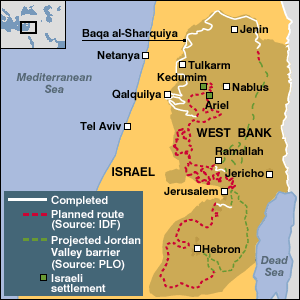
When complete, the illegal annexation wall will stretch for 724 kilometers around the West Bank, further isolating the entire population. 350 kilometers of the wall have already been constructed. Approximately 99% of the wall has been constructed inside the West Bank itself, confiscating more Palestinian land.
Many of the main roads that lead to Palestinian communities in the West Bank are closed or fully controlled by IOF.
IOF have continued to restrict access of Palestinian civilians from the West Bank to East Jerusalem, through a strict system of permits and a network of checkpoints.
IOF have completed controlled access to the Jordan Valley through 4 permanent checkpoints established at its entrances. Palestinians living outside the area are not allowed to enter it without permits.
Settlement activities and expansion of settlements impose additional restrictions on the movement of Palestinian civilians.
IOF have continued to restrict access to gunfire areas and natural reserves, which constitute about 26% of the total area of the West Bank.
Israeli military checkpoints restrict the movement of goods throughout the West Bank.
Palestinian civilians continue to be harassed by IOF in Jerusalem, and across the West Bank, including being regularly stopped, searched and even arrested in the streets by IOF.
Israel has imposed a tightened closure on the West Bank. During the reporting period, IOF imposed additional restrictions on the movement of Palestinian civilians:
Jerusalem: IOF have continued to impose severe restrictions on the movement of Palestinian civilians to and from the city. Thousands of Palestinian civilians from the West Bank and the Gaza Strip have been denied access to the city. IOF have established many checkpoints around and inside the city. Restrictions of the movement of Palestinian civilians often escalate on Fridays, preventing young Muslim Palestinians from praying at al-Aqsa Mosque.
Qalqilya: IOF have continued to impose severe restrictions on the movement of Palestinian civilians. On Saturday, 26 May 2012, IOF established 3 checkpoints at the around Qalqilya.
Jenin: IOF have continued to impose severe restrictions on the movement of Palestinian civilians. At approximately 15:30 on Thursday, 24 May 2012, IOF established a checkpoint on Qabatya-Marka road, south of Jenin.
Tulkarm: IOF have continued to impose severe restrictions on the movement of Palestinian civilians. At approximately 08:00 on Thursday, 24 May 2012, IOF established a checkpoint at the entrance of Qiffin village, north of Tulkarm. At approximately 10:30, established a checkpoint at Beit Leed intersection, east of Tulkarm. At approximately 17:00, IOF established a checkpoint on Tulkarm-Qalqilya road, south of Tulkarm. At approximately 22:00, Israeli soldiers positioned at Ennab intersection, east of Tulkarm, imposed additional restrictions on the movement of Palestinian civilians. At approximately 09:00 on Saturday, 26 May 2012, Israeli soldiers positioned at Ennab checkpoint, east of Tulkarm, imposed additional restrictions on the movement of Palestinian civilians.
Arrests at Military Checkpoints:
At approximately 11:00 on Thursday, 24 May 2012, IOF moved into Hijja village, east of Qalqilya. They patrolled in the streets and established a checkpoint at the entrance of the village. They arrested Mohammed Ghaleb Masalha, 27.
4. Efforts to Create a Jewish Demographic Majority in East Jerusalem
Israeli occupation authorities have continued efforts aimed at creating a Jewish demographic majority in East Jerusalem.
· At approximately 23:00 on Monday, 28 May 2012, IOF, accompanied by bulldozers, moved into Hazma village, northeast of Jerusalem. They demolished some civilian facilities as follows:
1. They demolished a 300-square-meter fuel station and a car wash belonging to Mustafa ‘Awad al-Khatib. They also confiscated 10,000 liters of benzene, 10,000 liters of diesel, 7 fuel pumps and a car wash pump. Al-Khatib estimated his loss at approximately 0.5 million ILS.
2. They demolished a 50-square-meter car maintenance workshop belonging to Marwan Sa’id ‘Aabdin.
3. They demolished a 50-square-meter car maintenance workshop belonging to Ameer Sa’eb al-Khatib.
4. They demolished an 80-square-meter cafeteria belonging to Mohammed ‘Abdul Karim al-Khatib.
5. They demolished a cafeteria and confiscated a container and all equipment of the cafeteria belonging to Munther Ershid.
6. They confiscated 5 motorcycles belonging to Noah al-Khatib.
7. They confiscated 4 fuel pumps, 4 fire extinguishers, 8,000 liters of benzene and 3,000 liters of diesel from a fuel station belonging to Fazza’ Saladin.
On Tuesday, 29 May 2012, the Israeli Haaretz daily reported on its website that the Israeli Municipality of Jerusalem, in cooperation with the Israeli Ministry of Tourism, would allocate 4 million ILS for a new settlement project in Silwan village to the south of the old town of Jerusalem, allegedly to encourage tourism in “David Town” settlement outpost in the context of the so-called “National Park Project.” The newspaper indicated that the financial committee of the municipality approved last week the transfer 1.1 million ILS in addition to 900,000 ILS that was transferred last year, and the Ministry of Tourism would transfer two million ILS. The deputy mayor of Jerusalem, Pepe Alalu, from Meretz Party, who voted against the project, stated that “the municipality and the ministry again make maneuvers to transfer funds to an association that attempts to control Silwan village.” He pointed out that the decision affects cultural associations in Jerusalem.
5. Settlement Activities and Attacks by Settlers against Palestinian Civilians and Property
Israel has continued its settlement activities in the OPT in violation of international humanitarian law, and Israeli settlers have continued to attack Palestinian civilians and property.
At approximately 09:00 on Thursday, 24 May 2012, IOF delivered a military order to the Palestinian liaison according to which they would seize 29 dunums of Palestinian land in Deir Estia village, northwest of Salfit, for security and military purposes and to combat “terrorist attacks.” According to the order, the land would be seized until 31 December 2014.
At approximately 11:00 on Thursday, 24 May 2012, IOF moved into Hijja village, east of Qalqilya. They handed a notice to Halim Na’im Da’as ordering the demolition of his two-storey, under-construction house. They also ordered Maher ‘Abdul Rahim Khalifa to stop the construction of his house. They claimed that the two civilians did not obtain licenses for buildings.
At approximately 16:00 on Thursday, 24 May 2012, a number of Israeli settlers from “Yits’har” settlement, which stands on the lands of Madama village, south of Nablus, set fire to some area of land in the south of the village. A number of Palestinian civilians gathered and attempted to extinguish fire. They and fire fighters were able to extinguish fire. In the meantime, Israeli settlers, escorted by IOF, attacked Palestinian civilians. Israeli soldiers also arrested Ahmed and Mohammed Bassam Nassar, 20 and 23 respectively.
At approximately 13:00 on Saturday, 25 May 2012, a number of Israeli settlers from “Yits’har” settlement set fire to wooden areas in the southeast of ‘Ourif village, south of Nablus. Large wooden areas were burnt and fire extended to cultivated lands. Dozens of Palestinian civilians arrived at the area and were able to extinguish fire.
At approximately 15:30 on the same day, Israeli settlers set fire to Palestinian agricultural lands in al-Qisma and al-Marah areas in the north of ‘Ourif village, south of Nablus. A number of Palestinian civilians rushed to the affected areas, where they found Israeli settlers and IOF stationed there. Clashes erupted between the two sides, during which Israeli soldiers intensively fired tear gas canisters. As a result, a number of civilians suffered from tear gas inhalation and we forced to move back to the village. Soon, they heard the sounds of shooting coming from the mountain located between the village and “Yits’har” settlement. They went to the area to check what happened. When they arrived at the area, they found Najeh As’ad al-Safadi, 21, handcuffed and bleeding. They evacuated him to a hospital in Nablus. According to medical sources, he was seriously wounded by a bullet to the abdomen. This attack was the second of its kind in less than one week. On 19 May 2012, Nember ‘Assaira, 24, from Southern ‘Assira village south of Nablus, was wounded by a bullet to the right eye. An Israeli settler fired at ‘Assaira, while IOF were present in the area.
On Tuesday morning, 29 May 2012, IOF moved into al-Baq’a area in the east of Hebron. They razed at least 30 dunums of cultivated land and destroyed their irrigation infrastructure, which belong to the al-Rajabi and Jaber families. It is worth noting that there is a plan to expand the nearby “Kharsina” settlement as 500 new housing units will be built in the settlement.
At approximately 16:30 also on Tuesday, 29 May 2012, an Israeli settler from “Kidoumim” settlement, northeast of Qalqilya, violently beat Nihad Mofeed Yamin, 19, from Jeet village northeast of the town. As a result, Yamin was injured in the right eye.
…………………………………………………
Recommendations to the International Community
1. PCHR calls upon the High Contracting Parties to the Fourth Geneva Convention to fulfill their legal and moral obligations under Article 1 of the Convention to ensure Israel's respect for the Convention in the Occupied Palestinian Territory. PCHR believes that the conspiracy of silence practiced by the international community has encouraged Israel to act as if it is above the law and encourages Israel continue to violate international human rights and humanitarian law.
2. PCHR calls upon the High Contracting Parties to the Fourth Geneva Convention to convene a conference to take effective steps to ensure Israel's respect of the Convention in the OPT and to provide immediate protection for Palestinian civilians.
3. PCHR calls upon the High Contracting Parties to the Fourth Geneva Convention to comply with their legal obligations detailed in Article 146 of the Convention to search for and prosecute those responsible for grave breaches, namely war crimes.
4. PCHR calls for the immediate implementation of the Advisory Opinion issued by the International Court of Justice, which considers the construction of the Annexation Wall inside the West Bank illegal.
5. PCHR recommends that international civil society organizations, including human rights organizations, bar associations and NGOs, participate in the process of exposing those accused of grave breaches of international law and urge their governments to bring the perpetrators to justice.
6. PCHR calls upon the European Union to activate Article 2 of the Euro-Israel Association Agreement, which provides that Israel must respect human rights as a precondition for economic cooperation between the EU states and Israel. PCHR further calls upon the EU states to prohibit import of goods produced in illegal Israeli settlements in the OPT.
7. PCHR calls on the international community to recognize the Gaza disengagement plan, which was implemented in September 2005, for what it is - not an end to occupation but a compounding of the occupation and the humanitarian crisis in the Gaza Strip.
8. In recognition of ICRC as the guardian of the Fourth Geneva Convention, PCHR calls upon the ICRC to increase its staff and activities in the OPT, including the facilitation of family visitations to Palestinian prisoners in Israeli jails.
9. PCHR appreciates the efforts of international civil society, including human rights organizations, bar associations, unions and NGOs, and urges them to continue their role in pressuring their governments to secure Israel's respect for human rights in the OPT and to demand Israel end its attacks on Palestinian civilians.
10. PCHR calls upon the international community to pressure Israel to lift the severe restrictions imposed by the Israeli government and its occupation forces on access for international organizations to the OPT.
11. PCHR reiterates that any political settlement not based on international human rights law and humanitarian law cannot lead to a peaceful and just solution of the Palestinian question. Rather, such an arrangement can only lead to further suffering and instability in the region. Any peace process or agreement must be based on respect for international law, including international human rights and humanitarian law.
…………………………………………………………
Public Document
For further information please visit our website (www.pchrgaza.org) or contact PCHR’s office in Gaza City, Gaza Strip by email ( pchr@pchrgaza.org ) or telephone (+972 (0)8 282 4776 – 282 5893).
One dunum is equal to 1,000 square met