Showing posts with label Ilan Pappé. Show all posts

Monday, July 22, 2013

Third interview with Ilan Pappé: “All international activists that come to Palestine should be VIP’s…they should Visit, they should Inform and they should Protest”


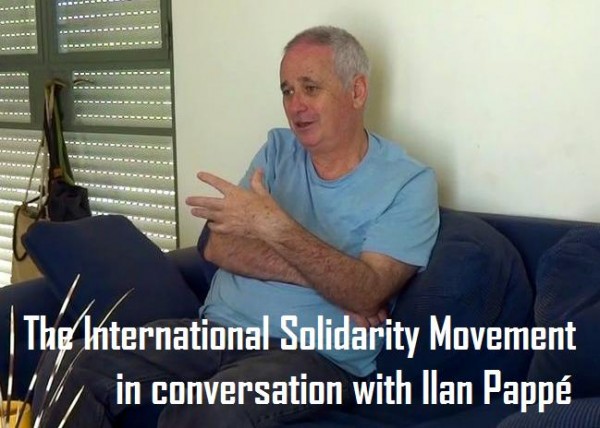
Ilan Pappé is an Israeli academic and activist. He is currently a professor at the University of Exeter (UK) and is well known for being one of the Israeli “new historians” – re-writing the Zionist narrative of the Palestinian Israeli situation. He has publicly spoken out against Israel’s policies of ethnic cleansing of Palestine and condemned the Israeli occupation and apartheid regime. He has also supported the Boycott, Divestments and Sanctions (BDS) campaign, calling for the international community to take action against Israel’s Zionist policies.

Activists from the International Solidarity Movement had the opportunity to talk to Professor Pappé about the ethnic cleansing of Palestine, Israeli politics and society and the role of the international community and solidarity activists in Palestine, resulting in a three part series of interviews which will be released on the ISM website in the coming weeks.

This is the final section; the role international community and solidarity activism in Palestine. Find part one on the ethnic cleansing of Palestine here and part two on Israeli society and politics here.
 
International Solidarity Movement: If, as you said in the previous interview (Israeli politics & society), support from the European Union (EU) and the USA is not going to stop, what could the international community do or what should change in order to force Israel to implement and respect international standards?

Ilan Pappé: We need a European spring. In the sense that we all know that if the European political leaders would only reflect what the European people want, the policy of European countries would be much tougher on Israel. Today, governments do not reflect what the people want or think. So the question is how do we transfer the pro-Palestinian sentiments of the people of Europe to the governments of Europe. By the way, this situation is the same in the USA.
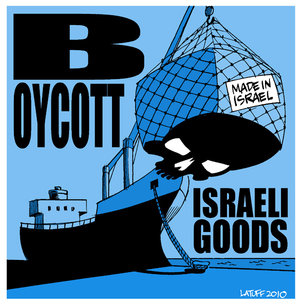
I don’t think that Americans are more pro-Palestinian than Europeans, but they are starting to have enough of Israel and they would like the USA to concentrate on their own growing internal issues. But again, political leaders do not represent this wish. We had the same problem in South Africa; it took 21 years for the first European civil act against South African apartheid, which came in the form of economic sanctions. So it’s a very long process. What the international community must do is find ways of convincing their political leaders that it is both ethically and politically better to adopt a much tougher policy against the illegal Israeli occupation. The EU is a good example here because they have strong connections and relations with Israel, they essentially treat them like a member of the EU. When the boycott campaign started, it was the EU who first tried to get Israel to act in a different manner. That was just a small beginning, there is still a lot to be done, but for me, this is the right direction: a process from below towards the political elites.

ISM: There are many European politicians that would like Israel to be a member of the EU. Do you think this is possible, and if so, what will that lead to?

IP: Maybe is a good idea because then Israel would need to change its entire governmental policy, which is currently violating many EU laws. On the other hand, that could be a problem because it may just lead the different governments of the EU to accept Israel’s cruelty and violations. I still think that the best strategy is to explain to these pro-Israel politicians that history will judge them really badly because of their positions. The problem is that politicians don’t have the tendency to look beyond tomorrow. The only way is to explain to them that when this situation changes (in our case, when the occupation ends and when Palestine will be free), they will be on the wrong side in the history books, because they were the politicians that were supporting a state of apartheid.

 It is similar for those politicians who were supporting Benito Mussolini. If politicians feel comfortable with being on the wrong side, that’s okay. But if they want to be portrayed in the history books as people who were working for peace and justice, they need to change their positions and friendships before it is too late. Israel has been kept alive because it serves a lot of strategic and military functions for the West, not because of its morality. Reality isn’t how the Christian Zionists see the world; thinking that Israel should be supported because it represents some kind of moral value. This kind of support has been overcome today, and this is also thanks to the work of the BDS campaign, it is one of the few victories we had.

ISM: In which way is international solidarity useful? What is or what should be the role of international activists in Palestine?

IP: I think that international aid, which is a bit different from solidarity movements, is often problematic. On one hand, it allows the Palestinians some level of existence, but on the other it kind of pays for the occupation and for Israel’s mistakes and violations. But the International Solidarity Movement is different:  it is not about money but about people coming to help other people.  As long as this injustice is happening, I think it is really important that ISM keep coming. All international activists that come to Palestine should be VIP’s. I mean they should Visit, they should Inform and they should Protest. ISM is doing all these three together, but maybe sometimes one less than another, because of particular circumstances or because of the lack of resources, and this is a pity. I think it’s essential to do them all together.

I think that ISM’s main role is to be the ISM’ers of the outside world. I once visited the Basque country, and I noticed that there was a distance between ISM and the boycott movement there, which is a shame because they should definitely work together. What ISM sees in Palestine is the result of the BDS movement’s work outside Palestine, and it works. It is not only about solidarity on the ground, which is very important, but also solidarity from outside.

You cannot replace the liberation movement – the Palestinians have to liberate themselves, nobody can help them with that, not even I, but we can and we must show solidarity with their liberation. This solidarity can be shown on the ground, but mostly by acting in the country that activists come from. It is about finding the right balance. I remember one of the first ISM groups that came to Jenin, after the terrible massacre of 2002. The fact that somebody came, was interested and sympathetic and supportive, meant a lot to the people.

We can see how much effort the Israelis are putting into preventing you from coming here, and I think that’s a good indication – proof that you are doing something right. I would be worried if tomorrow Israel said all ISMers are welcome – that would mean you’re not doing something right.
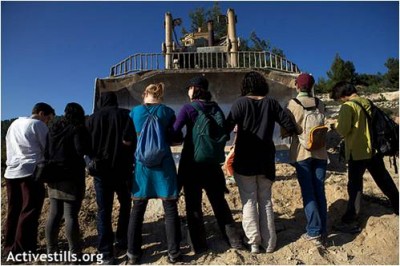
Protest against the construction of the wall in Al Walaja

ISM: What about the BDS campaign, do you think that an academic and cultural boycott could be an effective instrument against the Israeli occupation?

IP: I was always a great supporter of the BDS movement. As it did in South Africa, it will also play an important role in changing the reality on the ground here. But it is a long process and we need to be patient.

In the case of Israel, the academic and cultural boycott is particularly important, because Israel sees itself as a European and democratic country in the middle of the Arab world. ‘European’ not because of the economic relations it has with Europe, or because it sells tomatoes in Holland – among others it also has strong economic relations with China, Russia and Africa – but because it is part of the European cultural and academic elite. If European academic and cultural institutions say that they do not want to work with Israeli institutions because of Israel’s behaviour, I think it would send a very strong message.

The cultural and academic boycott (unlike the economic one, which only affects the occupied territories) makes a huge and direct impact on Israeli society, and it is only when that happens that Israelis will talk about what is happening in Palestine. For example, the only time that the Israeli press – and sometimes international media as well – talks about the occupation is when someone like Stephen Hawking says he is going to boycott an event organized by Israeli personalities. Before the spread of the boycott movement, it was only when there were bomb attacks in Israel that Israelis remembered that there is an occupation. Now this issue is brought up more regularly, when a famous pop group or author refuses to come, or when an important university in the USA says that they do not want to work with Israeli universities. This type of boycott is really important, and it is the main thing that the international community can do.
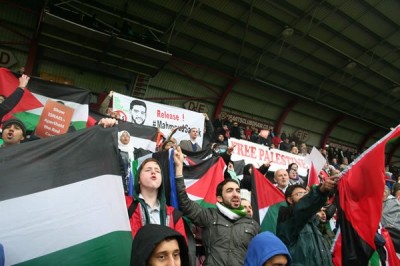
Pro-Palestinian activists hold a boycott protest during a football match between Scotland and Israel

International solidarity movements sometimes think that they should have an opinion regarding, for example, the one-state or two-state solutions, but this is actually not their business. It is up to the Palestinians and Israelis to decide how they are going to live. What international movements can do is to create the conditions for a reasonable dialogue. But we need to end the occupation before starting to speak about peace. The Israeli trick has for many years been to try to convince the world that peace will end the occupation. But we know that actually this goes the other way around: we end the occupation and then we will start to talk about peace. I think that ISM, the BDS movement and the Palestinian solidarity movements are all grassroots organizations that do not accept the Israeli diktat “Peace will end the occupation”. These organizations are not part of the peace talks but instead they work on ending the occupation and the apartheid.

ISM: What would you say to people that believe that cultural and sport events should not be politicized?

IP: Well, it was very effective in the case of South Africa. In fact white South Africans only began to think about apartheid when the big sports teams of South Africa were not invited to international sporting events. Moreover, I think that sport is political. For example, Israel is going to host the UEFA Under-21 football tournament, and the Palestinian football team has not been invited. Palestinian players from Gaza will not even be able to go to Israel and see the tournament. Sport is political if it is not free for everyone to participate.

Academia as well is clearly political. Israeli academics, when they are abroad, think they are Israel’s ambassadors. Synagogues abroad see themselves as Israel’s embassies. When Israeli academics see themselves as ambassadors, and represent something that most decent people abroad will see as unacceptable, then people have the right to show their rejection.

And nobody tells these people that they represent Israel, they say it themselves. There was a big debate in the Basque country about the Israeli singer Noah – whether people should boycott her concert or not. People went to her website and saw she had written that she represents Israel on her tour. So she wasn’t coming just as a singer, but as a representative of Israel. We are in 2013 and if you say that, it means you represent what Israel represents, and what Israel is doing today. Therefore you are a legitimate target of the boycott.

This is the last of a three part interview series: Ilan Pappé in conversation with the International Solidarity Movement. 

Second interview with Ilan Pappé: “The basic Israeli ideology – Zionism – is the problem”


Ilan Pappé is an Israeli academic and activist. He is currently a professor at the University of Exeter (UK) and is well known for being one of the Israeli “new historians” – re-writing the Zionist narrative of the Palestinian Israeli situation. He has publicly spoken out against Israel’s policies of ethnic cleansing of Palestine and condemned the Israeli occupation and apartheid regime. He has also supported the Boycott, Divestments and Sanctions (BDS) campaign, calling for the international community to take action against Israel’s Zionist policies.

Activists from the International Solidarity Movement had the opportunity to talk to Professor Pappé about the ethnic cleansing of Palestine, Israeli politics and society and the role of the international community and solidarity activists in Palestine, resulting in a three part series of interviews which will be released on the ISM website in the coming weeks.

This is the second section; Israeli politics and society. Find part one on the ethnic cleansing of Palestine here.

International Solidarity Movement: We were following the last Israeli elections and we were surprised to see that there was no actual talk about Palestine, it was all basically about internal issues. Then after the elections, Netanyahu commented about extending the settlements. What do you think about this?

Ilan Pappé: Your observation is correct. Israeli voters think that the problem of the West Bank has been solved, so they think there is no need to either talk about it, or come up with solutions. You propose a solution as an idea for an election only if you think there is a problem, which they think is not the case here. They think that what we have is good for Palestinians and good for Israelis. They think that the world is stupidly trying to create a problem that is not there, and is trying to be involved where there is no need to be. They think that even if there are still missiles coming from Gaza, Israel has a strong army that will answer back. So, if you speak with Israelis in the subway, they will tell you that there is not a problem between Israel and Palestine.

The only thing that makes Israelis think about Palestine is when the boycott campaign is successful, like what happened recently with Stephen Hawking. Do you know what the problem is? 95% of Israelis don’t even want to go to the West Bank, so they don’t know what is really happening. Or they know what is happening only from their children who are serving as soldiers. But their children don’t tell them about the checkpoints, the arrests from homes and all the other awful things. Israelis could know if they wanted to – they have the internet – but they don’t want to. For example in Tivon, my neighbourhood, everybody votes for the left, but if you ask them if they have ever seen a checkpoint or the apartheid wall, or if any one of them wants to go to the West Bank and see what the soldiers and settlers are doing, they will say no. They’ll tell you that’s not their problem. They have other problems – standard of living, house prices, the new car, the education of their children etc.

ISM: Yair Lapid, the head of the Ministry of Finance of the new coalition government, stated on 20th May that Israel is not going to stop the colonization of the West Bank or end subsidies for illegal settlers, which in fact will not only continue but increase. Do you think that any switch of parties in power could truly make an impact on this situation?

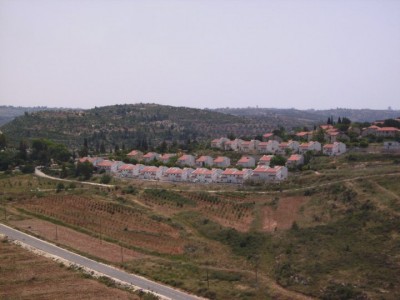
Halamish settlement, built on Nabi Saleh’s land (Photo by ISM)
IP: No. We haven’t had any party or leader different from the others, including Rabin, who became a hero after he was shot. Israelis like Lapid are always busy implementing policies so that the land has no Palestinians – so in this sense Lapid is just continuing what everyone before him was doing. The problem they have is not technical – they know how to do it, they have a script. They do not build new settlements, but they allow the natural growth of the current settlements, while Palestinians are not allowed natural growth. Then they say they’re not building a new settlement, but need to build a new neighbourhood because the settlement population has grown. So you can see from this that they do not have any technical problem, it’s more that they maintain this funny dialogue with the world: “You know that we are colonizing, you know that we are ethnically cleansing the Palestinians, you know that we are keeping them in prison, but still we are playing this game where we are speaking about a peace process.”

The only problem that Israel has – although within 10 years I unfortunately don’t believe it will be a problem anymore, unless we change something – is that they still think that what they’re doing will never be accepted by the world, so they think they need to find a new language for what they’re doing. But practically on the ground I don’t think there has been one day since 1967 that something was not built by the Israelis in the West Bank, whether it’s a house or a flat or a road or a balcony, it goes on and it will continue.

Israel knows that the EU and the USA will not stop supporting them, and they’re right. So they will talk about stopping colonization, but they will not actually stop it. This is something to worry about because that’s the reality. Lapid comes from the new generation of politicians and I think that when you are new in politics you say a bit more openly what you are doing. Then, like Silvio Berlusconi, when you have another term, you stop saying what you are actually doing. So, if Lapid were to become Prime Minister, he would stop saying what he’s doing, he’d say, “we are not building, we are just fabricating.”

Today, there is no hope for a change from within the Israeli political system. This system is just going to get more and more right wing, and less and less willing to change Israel’s unilateral policies.

ISM: There is this new far-right party “The Jewish Home” that just entered the government following the recent elections, with leader Naftali Bennet, who became Minister of Religious Services and Industry, Trade and Labour. What kind of change will that bring?

IP: He is a very clever man, he comes from a settlement, and his main agenda is to strengthen the connection between the settlements and Israel. This was not openly his agenda during the elections. At that time he was talking to young Israelis in Tel Aviv about how nice it is to be Israeli, and saying that he would bring back pride in being Israeli – and it actually worked, they liked him. It was all about this idea of the ‘great nation’. And he added Judaism to this – saying it is not just good to be Israeli, but to be a Jewish Israeli. He is young, he was in the army, he was a military hero and a successful businessman. But he is not so different from Lapid, they live the same way – “it doesn’t matter whether you are from a settlement or from Tel Aviv, we are all from Israel”.

ISM: Do you think that the settlers will have more impact on Israeli politics because of Bennet’s success?

IP: Yes, I think so, but this is not so important. It doesn’t matter if you are from a settlement or from Tel Aviv, or if you are on the right or on the left. The basic Israeli ideology – Zionism – is the problem. I think that as long as Zionism is regarded as an ideal concept, the same policies will continue. If Israel has a more right-wing government – for example Netanyahu’s government compared to the Barak government – then the differences are small. You just have a few more checkpoints and a bit more brutality. But I think in the end it’s really just the same. What matters is not the government of Israel, but how much the Palestinians are willing to accept. If they are willing to accept the current reality, then Israel will allow them to work within Israel, remove some of the checkpoints, give them some more autonomy. But the moment Palestinians show some form of resistance, Israel is going to repress them brutally. Everything is about how much Palestinians accept the Israeli diktat.

ISM: You previously said that there is no more hope for a change at the political level in Israel. But on the other side, in what way do you view today’s Israeli citizens’ commitment against the occupation? How important is it that the present and future Israeli society challenges this form of colonization?

IP: I think that the forces that oppose the occupation are very small, but there have been two positive developments. First of all, the rejection of the occupation is growing and secondly, it is led by the new generation, not like before. This is an essential element. But, pressure from the international community and the Palestinian resistance will be the main factors that will bring down the occupation. One day, when we will need to rebuild a new society, it will be much better to know that there were many Jewish people who were fighting against the occupation. When the occupation ends and takes its apartheid with it, I am sure that a lot of Jewish people will say that they were against it, like the white South Africans said at the end of their apartheid system, but everybody knows that it was not the case during that period. It is good to see that this wave is growing every day. Nonetheless, a lot of Israelis, they still don’t know that there is a military occupation! For the future it is essential that this view changes, and it is changing.

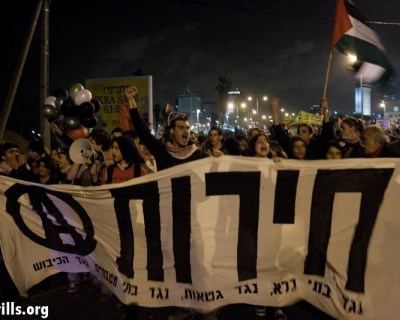
Israeli activists protesting the Gaza massacre in 2008-2009 (Photo by Activestills) Editors Note: 94% of Israelis wanted to see Gaza wipe off the map during the war crime called "cast lead"

ISM: Young Israeli people often feel criticized when they travel abroad. Do you think that this criticism has an impact or influence on Israeli society?

IP: Yes, I think it’s good to criticize young Israelis abroad. Some of them have actually changed because of that, no doubt about it. There’s a wonderful YouTube clip which shows what happens to young Israelis abroad. The Israeli military used to show this clip about young Israelis going abroad, to India. It was a clip especially against the refuseniks – people who refuse to serve in the army. In the clip they’re all sitting with young nice Indian girls, then some young Europeans come along and ask the Israelis what they did in the army. One speaks about the time he was a commander and about how cool it was to be in the army, and the Europeans look at him amazed, like he’s a hero. Meanwhile, the refusenik seems ashamed, looking down, without saying anything, basically really uncomfortable because he didn’t serve in the army. So this Israeli anti-apartheid organization made a counter-video, with the same setting, but instead of being soldiers they were Israeli activists, and the ashamed person was the one who served in the army, he was the one feeling really uncomfortable.

Now in 2013, some young people do not buy the whole story of anti-Semitism. They meet people abroad of the same age who know about the occupation, and where older people might just say that the people are neo-Nazis or something, young people are more likely to see the difference between being against the occupation and being anti-Semitic. This is an important new development, which I have seen with my own eyes.

ISM: What are the long term effects, social and psychological, on Israeli youth because of military conscription?

IP: Military conscription frames your mind. It makes you see human beings through a rifle and therefore you dehumanize them. It makes you very insensitive to suffering of others and at the same time makes you very racist. It also makes you limited in the way you can think about new options in life, because power obscures your mind. In any kind of situation you will think that the only way out from a state of affairs is the use of force. This has very negative effects on Israeli youth and it is clearly just part of the heavy indoctrination they face throughout life.

Young Israelis do not often speak about the psychological problems that come afterwards. I went to the psychiatric department in Israel and the vast majority of people are young Israelis who served in the army. This is a secret in Israel, nobody talks about it.  Two days ago a young boy who just finished his military service went into a bank that refused to give him a loan. He ended up shooting four people to death. This is just one example of the impact and effects of military conscription and militarization on the Israeli society.


ISM: How does it feel to live in Israel and at the same time be against the state? What are the consequences?

IP: It’s a fact that there are not many cases like mine and I pay a price for my position. So far, people like me pay a price not in the sense that the government is chasing them, it is different from other countries. Israel is such a racist state that it won’t do that to Jewish people. What they do instead, is to encourage society to punish you. The fact that I had to leave Haifa University is the result of this. They aim at the place where you work. For example, we had 4 brave former pilots that refused to serve in occupied Palestine because of what Israel was doing there – they were forced to leave their jobs outside of the military.

So, the public sphere or even your family or your friends make you pay a price, because you are considered a traitor. The reward you get is that you feel better about yourself and when you go abroad, people respect you. This, I hope, will encourage people to pay the price. If the Palestinians did what some Israelis are doing, they would just find themselves in jail. The Jewish people will maybe lose their job, be insulted, be hated by their neighbours, students. It is a long but really important process.

ISM: How did they kick you out from Haifa University?

IP: What they did is something called a special university court. They wanted to judge me as a traitor and kick me out of the university. This resulted in an international outrage because luckily, I was already well known at this time in the academic world, so they couldn’t go through the court process. What they did instead was to make it impossible for me to teach: they stopped my teaching allowances, they persecuted my PhD students, they gave me small classes, they told everyone at the university not to sit with me, not to speak to me. It was the director who gave the “orders”. He told to the other teachers that they would put their own career at risk if they violated these rules. They never formally fired me but I decided that that was enough, so I left.

Today there are many similar cases throughout Israel but speaking out against Israeli policies as an academic has now become more difficult than before, since in 2012 a new law was passed in the Knesset. This law says that if you are an Israeli academic and you support openly the academic boycott of Israel or you speak against Israel’s policies and actions, they have to fire you or you could even be arrested. After all, a large number of Israeli academics against the occupation created the “Israeli Academic Committee for Boycott”. These people are suffering and will never be able to become professors or further their academic careers – but more importantly I think that they feel better than the others. After this draconian law was passed, even more people decided to speak openly against the Israeli occupation or apartheid and for now, nobody has actually been arrested. How can Israel speak about democracy when our supposed freedom of speech is being violated so clearly.

This is the second of a three part interview series: Ilan Pappé in conversation with the International Solidarity Movement. Look out for the final part on the role of the international community and solidarity activism next week.
Sunday, July 7, 2013

Interview with Ilan Pappé: “The Zionist goal from the very beginning was to have as much of Palestine as possible with as few Palestinians in it as possible”

“The Zionist goal from the very beginning was to have as much as Palestine as possible with as few Palestinians in it as possible”

Posted on: July 2, 2013 | 2nd July 2013 | International Solidarity Movement | Haifa 
 Ilan Pappé is an Israeli academic and activist. He is currently a professor at the University of Exeter (UK) and is well known for being one of the Israeli “new historians” – re-writing the Zionist narrative of the Palestinian Israeli situation. He has publicly spoken out against Israel’s policies of ethnic cleansing of Palestine and condemned the Israeli occupation and apartheid regime. He has also supported the Boycott, Divestments and Sanctions (BDS) campaign, calling for the international community to take action against Israel’s Zionist policies.

Activists from the International Solidarity Movement had the opportunity to talk to Professor Pappé about the ethnic cleansing of Palestine, Israeli politics and society and the role of the international community and solidarity activists in Palestine, resulting in a three part series of interviews which will be released on the ISM website in the coming weeks.

This is the first section; the ethnic cleansing of Palestine.  

International Solidarity Movement: In your book “The Ethnic Cleansing of Palestine” (2006) and in your different speeches, you declare that Israel’s policy in Palestine could be qualified as a policy of ethnic cleansing. Has this strategy changed now or has the ethnic cleansing continued? If so, how has it continued?

Ilan Pappé: Before choosing the title for my book “The Ethnic Cleansing of Palestine”, I thought a lot because I knew the connotations, I realised that for too many people it would be too radical. I remember even my publisher had reservations about it. But then I checked the American State Department website about ethnic cleansing and the description of what ethnic cleansing is and it fitted so well with what was and is going on in Palestine. This description does not only describe an act of expulsion but also its’ legal implications, which is in this specific case, is a crime against humanity. It also says very clearly that the only way to compensate an ethnic cleansing is to ask the people who were expelled whether they want to return or not.

The Ethnic Cleansing of Palestine by Ilan Pappé
About the second part of your question, if this ethnic cleansing is continuing or not? Yes, I think it has continued, by different means, but it has. However the Zionist ideology and strategy has not changed from its very beginning. The idea was “We want to create a Jewish state in Palestine but also a Jewish democracy”. So the Zionists need to have a Jewish majority all the time. Now, you can do that by bringing Jewish immigrants to Palestine, but that didn’t work, the Jewish people remained a minority. They hoped that the Palestinians for some reasons would just leave, but this didn’t happen. So, ethnic cleansing was the only real solution from the Zionist perspective, not only to have control over Palestine, but also to have a Jewish democracy even with a really small minority. In 1948 they [Zionists leaders] believed that there was a unique historical opportunity to solve the problem of being a minority in the land where they wanted to be a majority.

Ethnic cleansing is a huge and massive operation, which usually takes place in time of war, therefore you cannot always know how to finish it. At the end of 1948 they [Zionist leaders] had 80% of the land they wanted (Israel without the West Bank and the Gaza strip), and in it they [Jewish people] were 85% of the population, together with a small minority that we today call the Palestinians of 48. They did not expel these Palestinians but they imposed their military rules on them, which to me is another kind of ethnic cleansing. You don’t physically get rid of them but you make them leave their houses, you don’t allow them to move freely, you don’t allow them their basic rights. In this instance, it was not about dispossession by uprooting someone but instead by making them prisoners, aliens in their own land. In 1967 the territorial apartheid in Israel grew. Now they wanted the rest of the land of historical Palestine. They achieved this with the Six-day war. Then they did something absurd from their own perspective. In 1948 they threw out from the country about 1 million Palestinians and in 1967 they incorporated about 1 million and a half Palestinians (those who were living in the West Bank and Gaza strip). So again, they had a problem with the Jewish majority democracy. Palestinians became again a demographic threat.

In 1967 they also expelled Palestinians, mostly from Jericho, Bethlehem, Jerusalem, Nablus, Qalqilya, but we don’t know the exact numbers. In order to understand this particular ethnic cleansing afterwards, we need to look at how they solved their problems in 1967. The war was a big victory for Israel because they got the land that they always wanted, the land of the ancient biblical cities (like Jericho, Hebron and Nablus). They didn’t expel the Palestinians but they didn’t give them citizenship either. The problem is that they colonized the rest of the land, denied citizenship to the natives and then they told the world that they wanted peace. So what they did, and they still do, was lie to themselves and to the world about their intentions. All the peace processes were just a cover.

Now, what to do with this new demographic threat? (there are now around 5.5 million Palestinians in the whole region of historical Palestine) I call it ethnic cleansing by different means. Some of the Palestinians lost their homes (between 1967 and today an average of 300,000 to 400,000 Palestinians have been individually expelled). They were either expelled or when they were travelling abroad, for example during a business trip to Rome and they didn’t come back within a year, they lost their right to return. Even if they came back within a year and later they leave the country again, even only for a few days, they also lose their right to return. It is hard to describe the ethnic cleansing because it is only about individuals and they succeeded with many. Then they expelled the Palestinians from the biblical areas that they wanted to be purely Jewish, like the greater Jerusalem area, where a lot of people were forced to become West Bank Palestinians after the occupation of 1967.

The ethnic cleansing is not only taking place in the West Bank or Gaza strip. For example in the Galilee, Palestinians are not allowed to develop their cities and villages. Sometimes you don’t even need to expel people as long as you don’t allow them to expand, to build their infrastructure, to have a decent job. In fact, a lot of Palestinians in the Galilee left because of the policies of Judaisation. We also have ethnic cleansing of the Bedouins in the south (Negev). Next month (June 2013), Israel is planning to push 30,000 Bedouins out of their lands and homes, to put them into some special centres. A little bit like the Native Americans reservations. What we have here is a constant policy since 1948.

How can you solve the problem of a country that wants to be both Jewish and democratic? How can you maintain a situation by which those who are citizens are only one people? You can tolerate a small number of Palestinians, and this is actually good for Israel because it creates a façade of them being the “only democracy in the Middle East”. However 20% of Palestinians (that’s the current percentage of Palestinians living in Israel) is too much because they could hypothetically have an impact in the Israeli political system. So, how to proceed? In 1948 it was about taking them out of their homes, now they are doing it in a different way. They created an apartheid system within Israel and they make the West Bank a place where people lack citizenship.

Ethnic cleansing of Palestinian land, comparison between 1948 and 2000

ISM: What are the concrete administrative and legal obstacles for the Palestinians living in Israel?

IP: The Palestinians in Israel are discriminated on 3 levels. The first is legal. By law, the fact that you are Palestinian means that you have fewer rights than a Jew. The most important law in this regard is the law on land ownership. According to the Israeli law, the land in Israel belongs to the Jewish people and them only. As a non-Jew, you are not allowed to trade or to purchase land and we are talking about 93% of the land. That’s why the Palestinians can’t grow and expand within Israel. Other laws do not specifically talk about the Palestinians, this is an old Israeli trick. The law says that if you have not served in the army you cannot have full rights as a student for example. You won’t get student’s subsidies, health services allowances, social security et al. All those things that the Western countries try to give to their citizens come with the precondition of military service in Israel. It is a trick because the Israelis do not want the Palestinians to serve in the army, in fact they are not allowed even if they would want to. There is an exception when it comes to Orthodox Jews, they do not serve in the army but they are not discriminated because they have a special annex to the Israeli budget. The Orthodox Jews get the money that the state would have used if they would have served in the army. So, Israeli law speaks for itself because it says that if you are Palestinian, you are a second-class citizen.

The second obstacle is policy discrimination. With this I mean that theoretically all citizens are equal. But when you look at the allocation budgets for schools, roads, infrastructure, anything at all, the Palestinians always get half or less than half of what the Jewish communities get. Here in Israel, you can see if you are in a Palestinian village just by looking at the quality of the roads. This is even nastier than you realise, because you can only improve the quality of the village by collaborating with Israel.

The third level is the worst one. It is the one of the daily encounter that Palestinians have with whoever represents the law in Israel. We undertook research in Haifa many years ago, which showed that in court, for the same charges, Palestinians always, always, got – and still get – double the punishment than their Jewish counterparts got.

To these three levels I will add two things. The Palestinians know that in the eyes of the Israeli authorities they represent a demographic threat. They live their whole lives knowing that the state they live in see them as a problem and want to get rid of them. That does not just mean the overt discrimination they face, because on top of that they are psychologically destroyed from within. We are not even talking about immigrants, but about people who are living in their homeland.  This is exactly what Israelis do not understand, that the Jewish people were in the same situation when anti-Semitism was spreading around Europe.

Finally, if we want to compare this situation to South Africa, it is true that here we do not have a “petit-apartheid”, the one which for example creates separated benches and toilets for white and for black. Here it may not be visible to the public eye but is as bad as the one of South Africa.

ISM: The ISM team in Al Khalil (Hebron) has observed the expansion of mass child arrests, which have increased sharply in the last year. For example, 27 children aged between 7 and 16 were arrested on 20th March this year on their way to school. What do you think are the specific reasons behind these unjustified actions?

IP: First of all, this is not new. I remember I wrote an article some years ago for the London Review of Books entitled “Children in Prisons”. I also remember when I went to Ofer prison, near Ramallah, after a journalist had told me to go there and watch this children’s court. I saw many children together, all shackled and wearing orange prison uniforms, with a female judge who quickly accused them of throwing stones or something like that.

The policy of child arrests has intensified in recent years, and I think there are two specific reasons for this. Firstly, the Israeli secret services find it more and more difficult to get Palestinian informers. This is directly related to child arrests, and arrests without trial in general, because the main reason why the secret services want to make arrests without trial is that it gives them a really good chance to tell the arrested person that, if they want to be free, they have to work for the secret services. Nobody knows the numbers, but this succeeds. And it doesn’t need to be a sophisticated collaboration, maybe the person will just have to send a report every two weeks about something suspicious. And there’s nothing stronger than threatening a family by arresting their children. If you look at the graphs of child arrests since 1967, you will see that it goes up and down – this might be related to the number of collaborators that Israel can count on.

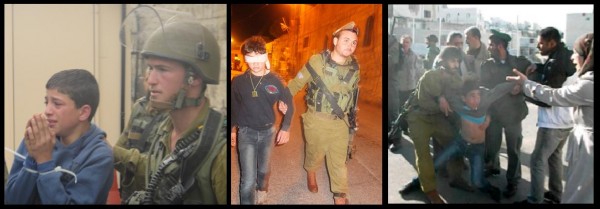
Some of the child arrests documented by the ISM in 2013 (Photos by ISM)
The second point is that Palestinians have changed their strategy since ‘67, to a non-violent-bordering-on-violent resistance (if you assume that stone throwing is violent). They used this way during the First Intifada, and many children participated in it. Then during the Second Intifada, there were many suicide bombers and weapons, and fewer children participating, therefore fewer child arrests. Now, the Israeli military and secret services feel that something is boiling in the West Bank and they are preparing for a Third Intifada. It is very clear that it will be less violent than the previous ones. The State of Israel feels, or wants to feel, like it already started. That’s why they are reporting constantly about the increase of stone-throwing, which automatically leads to more children being arrested and harassed. Israeli soldiers, of course, say that stone-throwing is a form of terrorism, putting lives in danger. Moreover, it makes soldiers feel humiliated, that they can’t respond brutally to this act and to non-violent protest (even if they actually do).

There is an interesting Israeli NGO named “There is a Limit”, whose members were part of the first refuseniks. All Israeli soldiers have a little green book of regulations in their pocket, called “The Soldier’s Guide”, about how to act in different situations, and this NGO made a copy of the book and called it, “Guide To War Crimes”. They took all the instructions of the real book and changed them, in order to show soldiers that they are actually asked to commit war crimes, especially against Palestinian children. But the soldiers don’t care. If you tell them that arresting a child is against international law, they will just say that international law is anti-Semitic, created specifically against Israel. They seem to forget that international law was actually developed also because of the Holocaust.

ISM: You said previously that the Zionist idea of creating a Jewish state didn’t change. What do you mean by the term Jewish state? Do you think that Israeli final goal is to have complete sovereignty on the whole territory of historical Palestine?

IP: The Zionist goal from the very beginning was to have as much as Palestine as possible with as few Palestinians in it as possible. There is no actual difference between what we today call left and right Zionism. The only difference is that the right wing speak their mind more, in the fact that they continuously let us know they want to take more and more land from the Palestinians. They do not care if it is not the right historical moment or if they have enough resources to do it or if the international atmosphere is not good. Whereas the left, the pragmatic left, say that they cannot take land all the time. So, for example, you need to look for good historical moments. Some of the left says that it’s enough to have 90% of historic Palestine for Israelis, with the last 10% for the Palestinians, who would also be denied Israeli citizenship.

This is the two state solution vision from the Israeli perspective. This solution was born as an idea of the Zionist left. They said give a little bit of the West Bank and the Gaza strip to the Palestinians and let them call it a state, even though it is not even connected. What they did is draw a map of the Palestinian state which only shows where the Palestinians live now, not one centimetre more. If you look at the map of the West Bank you can see it, Nablus is Nablus, there are no suburbs of Nablus. According to Israel if there are no Palestinians living there, it’s Israel, regardless of why they are not there. Yet, if you have a settlement, you will need a parameter to protect it. This partition is something that the Zionist left already came up with in 1967. Palestinians can stay where they are but cannot have more space.

West Bank closure map by OCHA – full version here
ISM: So this is the idea developed with the Oslo accords in 1993, which divided the West Bank into three areas (A, B and C)?

IP: Yes, this is correct. But this idea was developed, as I said, in 1967 by the leftist Zionists, way before the Oslo agreements. The great architect of all this was the Zionist Minister of Labour, Yagel Alon. In 1967 Alon wasn’t speaking about areas A, B and C specifically but instead, he was saying that if we want a solution we need to divide the West Bank into two areas, one under Israeli control and the other under Palestinian control. He said that he didn’t care if the Palestinian area would be called a state one day – he had no problem with that. The problem will be who controls the West Bank’s strategic areas and resources. Israel must control the air and the Jordan river and the Palestinians must have no army to stop this. The whole concept of Oslo, to my mind, was truly birthed by the Israelis in 1967.

ISM: In the occupied West Bank, land appropriation is a daily occurrence, especially but not only in Area C. Do you see a present or future parallel with South African’s Bantustans and the reservations of Native Americans at this rate?

IP: Yes. I think I already talked about this, but I will repeat it with a different focus.

Israeli strategists understand that they will not be able to physically get rid of all the Palestinians Palestinians as they will stay where they are. So, instead of getting rid of them, they are putting them in small prisons, so that they don’t feel they are part of Israel. You bring more Jewish people, you colonize, and in order to build houses for them you need to expropriate Palestinian land, because there is no Jewish land to expropriate, so you demolish Palestinian houses. Secondly, you build a separation wall between the Jewish space and the Palestinian space, and you expropriate more land, not only for the settlements but also to create a buffer zone, so that Jewish people and Arabs won’t live together. More importantly, you also take the best land – where the water resources are, and the quality of the land is good. And you take the good water from Palestinians and put it in the hands of the settlers, and make sure that the waste water flows onto Palestinian land. So it is even more cruel – not only do I take your good water, I also sell you bad water for double the price, which is just terrible. And as I said before, yes, I believe that there is a clear parallel between today’s situation in Palestine and the sad historical examples of Native Americans and South African apartheid.

This is the first of a three part interview series: Ilan Pappé in conversation with the International Solidarity Movement. Look out for the second part on Israeli politics and society next week
Source