Sunday, January 15, 2012

Palestinian Killed, Four Injured, In Rafah Explosion

by Saed Bannoura

 Palestinian medical sources in the Gaza Strip reported that one resident was killed and four others were wounded in an explosion that took place on Saturday evening at the house of the secretary-general of the Popular Resistance Committees, in Rafah, in the southern part of the Gaza Strip.

 Adham Abu Saliyya, spokesperson of the Higher Committee for Medical and Emergency Services in Gaza, reported that one of the four wounded residents in a very serious condition.

The explosion took place in the house of Sheik Zoheir Al-Qaisy who was unharmed as he was not home; the exact cause of the blast remains unknown.

The Popular Resistance Committee issued a press release stating that Khaled Jamal A-Qaisy, 38, was killed in the blast.

The brigades confirmed that its secretary-general was unharmed, and in a good health condition, contrary to some retort that claimed he was killed in the blast.

It also stated that it will release a statement regarding the nature and causes of the deadly explosion.

 http://www.imemc.org/article/62836

European aid convoy ‘Miles of Smiles 8’ arrives in Gaza

Miles of Smiles 8 enters Gaza
by Saed Bannoura

 The eighth in a series of vehicle convoys from European and Arab countries to the Gaza Strip reached Gaza on Saturday, bringing medical equipment and vehicles for the disabled.

 According to organizers, 48 European and Arab activists participated in the convoy, which consisted of a number of vehicles driving caravan-style from Europe through Arab countries and then entering Gaza from Egypt. The convoy is bringing two tons of medical supplies worth approximately $500,000 USD.

In addition, the convoy includes ambulances, vehicles modified for use by the disabled, and electric scooters. Previous convoys organized by ‘Miles of Smiles’ have brought infant formula, medicine, medical supplies and ambulances into Gaza.

Due to the Israeli blockade imposed in 2007, many of these items have been lacking in the Gaza Strip, leading to the preventable deaths of over 500 patients in the last five years. In addition, patients in Gaza are prevented from leaving the Strip by Israeli authorities, who require a special permit for medical treatment abroad which is rarely granted.

Numerous incidents have been documented of Israeli authorities forcing Palestinian patients from Gaza to agree to act as informants for the Israeli military in order to receive permission to leave the Gaza Strip for medical treatment. This type of medical coercion is a direct violation of the Fourth Geneva Convention and international law.

The Miles of Smiles convoy organizers say that they will continue to organize convoys into Gaza as long as the Israeli blockade remains in place.

The activists on this convoy, the eighth in a series, have been delayed in Egypt for several weeks due to the Egyptian elections. They were eventually granted permission by the Egyptian authorities to cross the Rafah border crossing into Gaza, and entered on Saturday January 14th.

 http://www.imemc.org/article/62837

Saturday, January 14, 2012

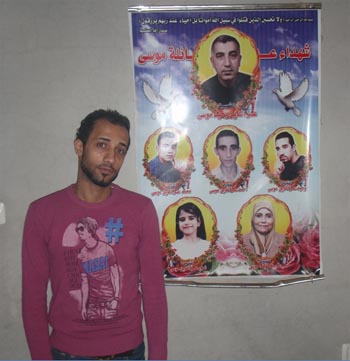
14 January 2009 – Muhammed Mousa

Mahammed Mousa
14 January 2012 | Palestinian Centre for Human Rights

“We would stay up late at night talking with each other about what had happened over the day, we were brothers, if ever I needed anything I could go to them and they would help me out”

On 14 January 2009, at approximately 21:00, Israeli aircraft targeted the Mousa family home near al Sabra pharmacy in the south of Gaza City. Izz Addin Wahid Mousa, 48, his wife, Maysara Afif Mousa, 48, their sons Wahid Izz Addi Mousa, 28, Ahmed Izz Addi Mousa, 27, Mohammed Izz Addi Mousa, 22, and daughter Nour Izz Addi Mousa, 15, were killed in the attack.

The physical scars caused by the attack are still clearly visible on 25 year old Muhammad Mousa. With nerve and bone damage in both his right arm and leg he has been left with a strong limp and his face displays patches of taut skin showing where he was burnt from the fire that engulfed his home. His injuries have left him unable to continue working in the local marble factory, leaving him unable to pick up the pieces of his life after losing his father, mother, sister and three brothers.

Like many who lost their homes during the offensive, Muhammad, has been forced to move frequently. He has moved  five times in the intervening period and, with another years rent due on his current home and no way to pay it, has not yet found stability and security. “After the attack I started rebuilding the destroyed home, but I couldn’t bear to live there, the incident would keep flooding back into my memory,” says Muhammad. “I went to live with my uncle, Hani, but he has a family of his own so I could not stay there.”

Emotionally, Muhammad has found himself hugely altered since the war and has had trouble sleeping since the incident. “At first I could not sleep at night at all, I would sit awake all night and might sleep for a while in the morning.” He now needs help doing basic things that others take for granted, such as preparing food to eat, which leaves him short tempered. “I lose patience very quickly, when I can’t do something myself I get hugely frustrated and become angry.” This is compounded by the sense of helplessness he feels regarding medical treatment for his injuries, which he says he was told by doctors is only available in Germany. He still requires extensive medical treatment on bone and nerves in his leg and for shrapnel wounds in his abdomen.

“I was in hospital for four months in Egypt (of which two and half months was in intensive care) without knowing the fate of my family. My sisters had initially told me that they were fine for the sake of my recovery. When I told them I was ready to come home they were forced to tell me the news that they had died, I immediately regressed and had to spend another two weeks in intensive care before being able to go.”

Muhammad has fond memories of his deceased brothers Wahid, Ahmed and Mohammad who he was very close to. It is clear he desperately misses their company. “We would stay up late at night talking with each other about what had happened over the day. We were brothers, if ever I needed anything I could go to them and they would help me out.” He says they are never far from his mind day or night, asleep or awake.

Muhammad shares the dreams of any young man for his future; he wants to get married, build a home, and one day have children. But he is sceptical his hopes will come true. “How can I provide for a wife and children, I cannot work, I cannot earn a living.” While he is optimistic about the outcome of legal action being taken on his behalf in Israeli courts he says what has been taken from him cannot be replaced, what he wants from the case is accountability for those responsible for his family’s death. “Money cannot replace what I have lost, I want to know why our home, which was nowhere near any military operations, was targeted, and why my family, who were not involved in politics, were killed.”

PCHR submitted a criminal complaint to the Israeli authorities on behalf of the Mousa family on 18 May 2009. To-date, no response has been received.

The series of narratives:
13 January 2009: Hibba al-Najjar
12 January 2009 – The Ayad family
11 January 2009: The Hamouda family
10 January 2009: Wafa al-Radea
9 January 2009 – The Abu Oda family
8 January 2009: The Al-Rahel family
7 January 2009 – The Mattar family
6 January 2009: Al-Dayah family
5 January 2009: Amal al-Samouni
4 January 2009: The Abdel Dayem family
3 January 2009: Motee’ and Isma’il as-Selawy
2 January 2009: Eyad al-Astal
1 January 2009: The Nasla family
31 December 2008: The Abu Areeda family
30 December 2008: The Hamdan family
29 December 2008: Balousha family
28 December 2008: The Abu Taima family
27 December 2008: The Al Ashi family

Two Palestinians attacked by settlers, then abducted by soldiers

by Saed Bannoura

 A number of fundamentalist Israeli settlers attacked, on Friday, two Palestinian youths in Ash-Shuhada Street, in the southern West Bank city of Hebron. According to eyewitnesses, Israeli soldiers arrived at the scene and kidnapped the two Palestinians; while the settlers were not even questioned.

 The Maan News Agency reported that the settlers violently attacked the two Palestinian youth while they were crossing the street, punched and kicked them repeatedly, and the soldiers “intervened” to kidnap the victims instead of the attackers.

The soldiers went on to handcuff the two Palestinians and took them to an undisclosed location.

Also on Friday, extremist settlers cut at least 100 olive trees that belong to Palestinians residents in the Central West Bank district of Salfit.

Fundamentalist settlers groups have recently stepped up their assaults against the Palestinians, their orchards and lands and their property, and even went on to burn and deface several mosques, and a church.

The settlers also defaced property that belongs to activists of the Israeli Peace Now Movement.

Fundamentalist settlers even attacked Israeli military and police vehicles. They blame the Palestinians and Israeli peace groups to the evacuation of some random settlement outposts that were dismantled by the army.

 http://www.imemc.org/article/62832

Settlers Cut More Than 100 Olive Trees Near Salfit

by Saed Bannoura

 A number of fundamentalist Israeli settlers cut on Friday more than 100 Palestinian Olive trees, including some ancient Roman trees that belong to residents of Yasouf and Jam’een towns, near the central Went Bank district of Salfit.

 Local sources reported that the settlers came from the Tapoah illegal settlement, and started cutting the trees that are located in Al-Mafqa’a area, near Yasouf.

The sources specifically blamed one settler who owns more than 100 sheep, as he repeatedly harassed the residents and is believed to be behind incitement that led to the attack.

The settlers are attacking Palestinian orchards and lands in that area in an attempt to force the Palestinians out, so that they can expand the settlement.

Earlier on Friday, settlers attacked and punched two Palestinian youth in the southern West Bank city of Hebron. Soldiers, stationed at the area, kidnapped the two Palestinians; the settlers were not even detained.

 http://www.imemc.org/article/62833

“If the Olive Trees knew the hands that planted them, Their Oil would become Tears.”
Mahmoud Darwish

Friday, January 13, 2012

Israeli Artillery Shells Central Gaza, Two Injuries Reported

by Alaa Ashkar

 Two Palestinians were injured on Friday midnight as Israeli artillery fired two missiles into the eastern area of Al-Breij Palestinian Refugee Camp, the central Gaza Strip.

 The Palestinian medical spokesman in Gaza, Adham Abu-Selmiyya, stated that medics reached the scene after receiving a relief call, and they have evacuated two injured people. Their injuries reported as moderate.

He further said that the two injured were transferred to the Al-Aqsa Brigades’ Hospital in Deir Al-Balah. The two injuries were described as moderate.

 http://www.imemc.org/article/62828

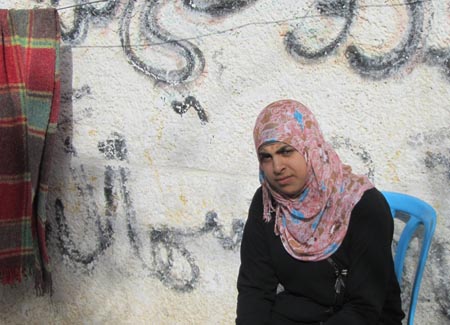
13 January 2009: Hibba al-Najjar

Hibba al-Najjar (17) sitting opposite her home in Khuza'a village
13 January 2012 | Palestinian Centre for Human Rights

“The first two years I could manage but this year I have been suffering a lot from the loss of my mother. When I see girls from my school with their mother or talking about their mother, I miss my mother even more. I need to have her with me.”


In the early morning of 13 January 2009, following two days of home demolitions, the Israeli army started to shell the village of Khuza’a and its surroundings, using high explosive and white phosphorous artillery shells. Israeli bulldozers, tanks and snipers were located on the edge of the village. At around 7:00 soldiers ordered the residents of eastern Khuza’a, to leave the area and move towards the centre of the village. Holding a white flag, Rawhiya al-Najjar (47) led a group of approximately 20 women in an attempt to leave as ordered. Shortly after the group turned the first corner a soldier shot and killed Rawhiya. Another woman in the group, Yasmin al-Najjar (23), was injured by two bullets when she tried to take Rawhiya off the road. Medical staff who tried to evacuate Rawhiya’s body were shot at and had to take refuge in a nearby house, and were only able to take the body from the street after more than 10 hours.

“I can still hear the bullet hit my mother in the head. I was standing right beside her when the soldier stepped into the doorway of the house ahead and shot her. I could see him,” says Rawhiya’s 17 year old daughter Hibba as she depicts the situation with her arms. “I keep wondering why they killed my mother while she was carrying a white cloth in the street, but why I was not killed when I was on the roof of our house earlier that morning.” Hibba still cannot make sense of what happened that day.

Hibba is an the only child. She lives with her father, Naser, his second wife, Nuha, and their three children. Her father married Nuha when it became clear that Rawhiya was not able to have any more children and convinced him to marry a second wife. Naser became unemployed after the full closure on the Gaza Strip was imposed. Now the family is dependent on aid and shared agriculture with relatives on lands next to the village, close to the border with Israel.

From the day of the incident Hibba and her family stayed away from the house for two weeks, saying it was too dangerous to move in that part of Khuza’a. For the two months after that they only went to their house during the daytime and spent the night at the house of relatives in a safer area.

Since the death of her mother Hibba suffers from nightmares, insomnia, stress, and bedwetting. “Before, I would sleep immediately. Now I can’t get to sleep at night,” says Hibba. Sometimes her father finds her sleepwalking and talking about her mother. Lately she has also begun to experience blurry vision and dizziness. When Hibba started to lose her hair a few months ago, Naser took his daughter to a hospital. The doctor told Hibba and her father that she needs to spend some time outside of the Gaza Strip. Naser is thinking of taking her to Egypt for a little while next summer. However, the closure and high costs make this option far from easy. Hibba says she would like to go out of Gaza but adds that “it will not make me forget anything.”

Hibba’s schoolwork has also been affected by the traumatic experience and death of her mother. “My mother used to help me with my homework and I used to be very good at school. Now my grades are lower and I am not able to focus in class. When I open a book I feel tired and remember my mother. Even when I study well for an exam, I often forget everything during the exam,” she says. Hibba enjoys subjects like Islamic religion and geography but feels sad knowing her scores have dropped a lot. This is the final year of high school for Hibba. However, she doesn’t think about what comes after the final exams next summer; “I don’t want to think long-term.”

Hibba does not like the month of January as it reminds here of the time of the offensive. However, she says 13 January is like any other day for her, “there is no difference with other days because I remember my mother every day regardless.” When she feels most sad she usually takes a chair and sits outside the house for a while. Sometimes talking to relatives and her best friend, who is also her neighbour, brings some relief. Hibba is glad to have such a good friend who tries to support her; “I can tell her everything. Without my friend I would have crumbled under the pressure of my loss.”

Hibba does not think about the future but rather relives what happened to her and her mother on 13 January 2009. “Since the morning I have been thinking a lot of the incident and how we left my mother in the street,” she says, having to pause after every few words. Many things in daily life remind her of her old life with and her future without her mother. “Whenever I see an old woman in the street I wonder if I will still have a clear memory of my mother when I am at that age.”

Discussing PCHR’s submission of complaints to the Israeli authorities regarding the killing of her mother, Hibba says she does not care: “Nothing can compensate for the loss of my mother but I wish that the soldier who shot my mother will be brought to justice.”

PCHR submitted a criminal complaint to the Israeli authorities on behalf of the al-Najjar family on 23 June 2009. To-date, no response has been received.

The series of narratives:
12 January 2009 – The Ayad family
11 January 2009: The Hamouda family
10 January 2009: Wafa al-Radea
9 January 2009 – The Abu Oda family
8 January 2009: The Al-Rahel family
7 January 2009 – The Mattar family
6 January 2009: Al-Dayah family
5 January 2009: Amal al-Samouni
4 January 2009: The Abdel Dayem family
3 January 2009: Motee’ and Isma’il as-Selawy
2 January 2009: Eyad al-Astal
1 January 2009: The Nasla family
31 December 2008: The Abu Areeda family
30 December 2008: The Hamdan family
29 December 2008: Balousha family
28 December 2008: The Abu Taima family
27 December 2008: The Al Ashi family