Monday, January 2, 2012

How baby Saheed died

Mark Klusener
 
IT IS a scene all too familiar in Gaza — an ambulance screeches to the front of the hospital and paramedics dash out, screaming for help. Crowds surge forward, trying to catch a glimpse of the victim. Suddenly, a paramedic holds something above his head and, for just a second, the crowds fall back, aghast at the horrific spectacle.

Held above his head is the blackened, bloated corpse of what appears to be a little girl. Her charred clothes are fused to her body and her limbs are in tatters. She has no legs.

The girl’s story never made the headlines; the pictures were too gruesome to air on Western television. Even Arab channels, notorious for showing graphic images of the Gaza conflict, balked at the photographs and most decided not to run them.

Had it not been for a local Palestinian camera crew at the hospital, her horrific experience would have gone untold.

Paramedic Ali Khalid describes it as the most traumatic thing he has ever seen.
Photographs capture tears streaming down the 48-year-old’s face as he raises the remains of the child to the crowds: “Where are the Arabs, where is Islam?”

He has been a paramedic in Gaza for more than 20 years and admits that the sights of injured and dead children haunt him.

“This girl and other children, I will never forget. I want to forget children being decapitated and burnt, but when I eat, sleep and walk, the picture of this girl is in my thoughts,” Khalid said this week.

Saheed abu Halima, who was 18 months old, was from Al Atatra, north of Gaza City, which experienced some of the heaviest Israeli bombardments.
The shell of her home still stands, but like the family of 11 that once lived there, it is shattered.

Only five of the nine children survived. As Israeli rockets rained down on Al Atatra three weeks ago, Ali abu Halima, six, said his father huddled together the children in the passage, thinking it was the safest place.

But Saed abu Halima was wrong. A rocket struck above their heads, decapitating him and one of his sons, and killing the other. The rest of the family were engulfed in flames.

As Daulat abu Halima, Saheed’s aunt, explained, the tragedy did not stop there.

“We loaded the family into two trailers pulled by tractors to take them to hospital. The first trailer made it through but the second was stopped by Israeli soldiers. They shot the driver and we all fled.”

During their operations in Gaza, the Israeli army restricted people from driving on roads and in some cases created roadblocks to cordon off areas from which they believed rockets were being fired.

Only days later were Palestinian paramedics able to reach the children. What they saw was horrific. It appears Saheed’s body was dragged off by dogs that gnawed away her legs and most of her lower abdomen.

Speaking from her hospital bed at the Al Shifa hospital, her mother, Subah Abu Halima, said: “I loved her the most. She was my favourite. She was the only girl.”

The 45-year-old mother has extensive chemical burns over most of her body, burns her doctor believes were caused by white phosphorous shells, the same burns that covered her daughter’s face and chest.

“After the rocket struck, there was fire everywhere. I tried to get to her but I couldn’t see anything. I heard her screaming ‘Mummy, mummy; hot, hot’, but I couldn’t reach her, and her cries stopped,” sobbed Abu Halima.

In life, Saheed was unnoticed and in death she is little more than a statistic. Her body, burnt almost beyond recognition and her flesh devoured by scavengers, was too horrific for people to see. But this image tells the story of one of about 380 Gazan children killed in the 22-day war between Israel and Hamas.

Israel claimed that the children were killed because militants fired rockets from civilian areas. Israeli Prime Minister Ehud Olmert even apologized to the people of Gaza for the innocent loss of life. But for many families, like the Abu Halimas, these words ring hollow.

IDF soldiers ordered to shoot at Gaza rescuers

Haaretz   
 
GAZA STRIP – “Rules of Engagement: Open fire also upon rescue,” was handwritten in Hebrew on a sheet of paper found in one of the Palestinian homes the Israel Defense Forces took over during Operation Cast Lead. A reservist officer who did not take part in the Gaza offensive believes that the note is part of orders a low-level commander wrote before giving his soldiers their daily briefing.

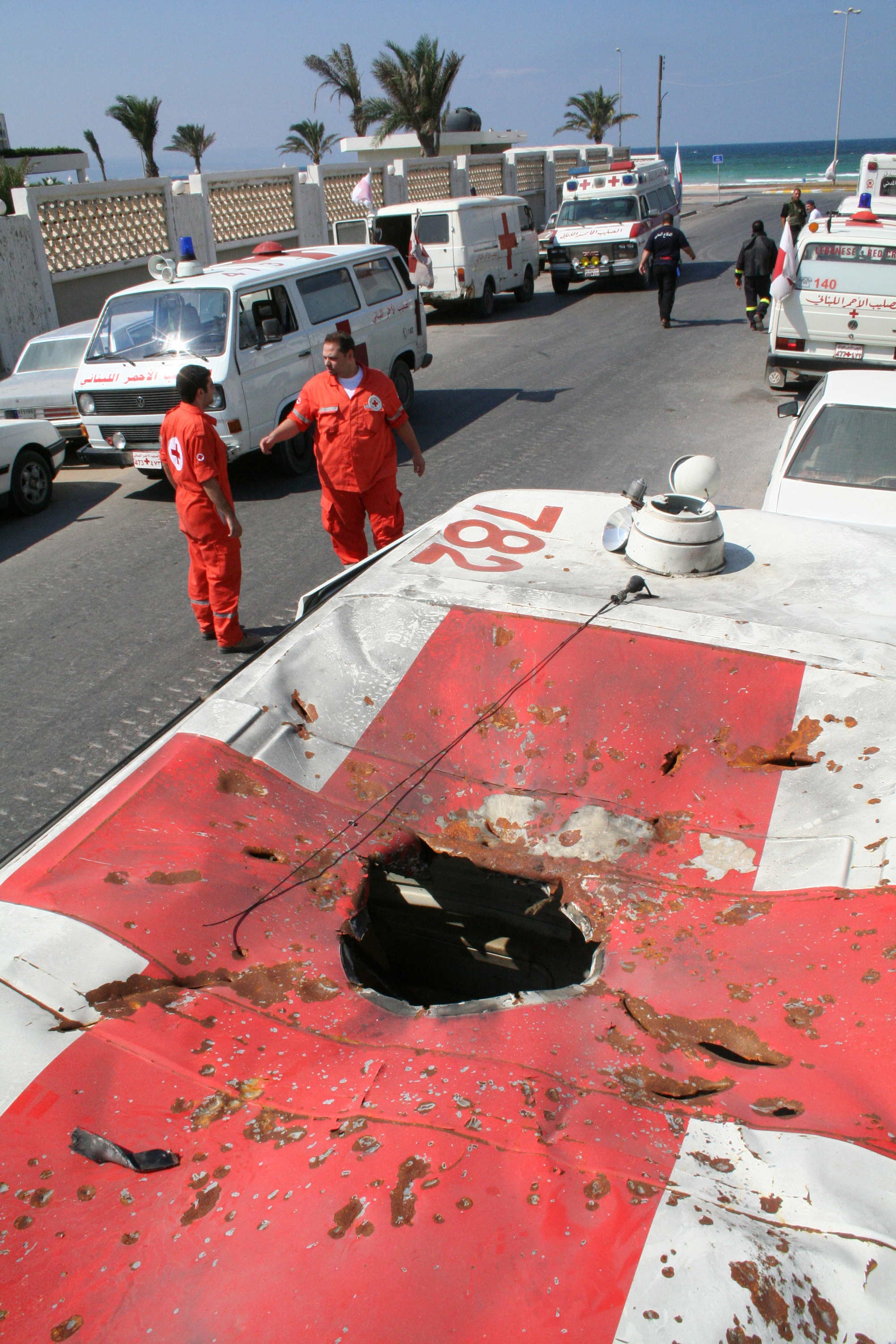
One of the main themes in news reports during the Gaza operation, and which appears in many testimonies, is that IDF soldiers shot at Palestinian and Red Cross rescuers, making it impossible to evacuate the wounded and dead. As a result, an unknown number of Palestinians bled to death as others cowered in their homes for days without medical treatment, waiting to be rescued.

The bodies of the dead lay outside the homes or on roadsides for days, sometimes as long as two weeks. Haaretz has reported a number of such cases, some of them as they happened. The document found in the house provides written proof that IDF commanders ordered their troops to shoot at rescuers.

The sheet of paper entitled “Situational Assessment” was found by a field researcher of The Palestinian Center for Human Rights in the home of Sami Dardone’s family in Jabal al-Rayes, east of Jabalya. The extended Dardone family lives in about 40 homes in this neighborhood, built on a hilltop. Some of the homes were taken over by the army to house troops during the offensive and to serve as sniping positions, or for shooting in general.

Most of the homes were seriously damaged when the IDF directly bombed them or other targets nearby at the start of the ground operation. This was also the reason the homes’ residents fled on January 4. When the residents returned to the neighborhood at the end of the offensive on January 18, they found that the IDF had completely destroyed some of the homes, in addition to those that had been damaged by shelling and others that were wrecked when soldiers broke in through the walls. Sometimes the soldiers needed explosives to break in.

A military source told Haaretz that “the document that was found is not an official document signed by a particular commander, and as such the IDF cannot comment on fragments of sentences that were jotted down on a piece of paper, and asks that this not be interpreted as directives and instructions that were issued by commanders.”

‘Situational assessment’

According to the reservist officer who did not participate in Operation Cast Lead and who received a copy of the document via fax, the “Situational Assessment” was written by a platoon commander, or at the highest level a company commander. The reservist says the author of the “Situational Assessment” was making notes to brief his soldiers based on a briefing that low-ranking commanders receive from senior officers.

The date on the sheet is “16.1.08,” clearly an error because it should read one year later. It comments on political and military events that occurred in mid-January 2009. It’s possible to conclude that the author is discussing the possibility of a cease-fire, which was being discussed publicly by Israeli officials at that time.

“The next 24 hours are important; there is a likelihood they [Hamas] will not accept the agreement,” the author writes. He also mentions the “Interior Minister.” The reference is probably to Hamas Interior Minister Said al-Sayam, who was killed on January 15 when the IDF bombed his home. Four members of his family and five members of a neighbor’s family were killed. Among the dead were four children.

The commander’s notes toward the top of the sheet are largely a short political briefing – for example, “the local leadership wants [a cease-fire], the external [Hamas leadership] is out of touch” – and an assessment of the enemy’s intentions – “the enemy would like to achieve a kidnapping [of soldiers], the destruction of homes.”

“Rules of Engagement” is written in the lower half of the sheet, along with one other category: – “Operational Routine.”

The following is written: “Rules of Engagement: Fire also upon rescue. Not on women and children. Beyond the tantcher – incrimination.”

“Tantcher” is what the IDF calls Salah al-Din – the route that runs the length of the Gaza Strip. The home of the Dardone family is east of the route, so it is possible to assume these are instructions on shooting at anyone crossing the route to the east into areas held by the IDF.

A reservist soldier who did not participate in Cast Lead says that to the best of his knowledge “incrimination” refers to the process of identifying whether a person approaching is a terrorist.

The reservist officer who did not take part in the Gaza operation spoke with reservists who said “incriminating” was a shoot-to-kill order, contrary to “suspect procedure,” in which shots are fired in the air and then at the legs.

The IDF spokesman said in response that “IDF forces were given unequivocal instructions not to fire at those identified as not being involved in the fighting, and to assist as much as possible injured Palestinians under battle conditions.”

The reservist officer told Haaretz that “according to the details mentioned in the paper it appears the author was a low-ranking officer who dealt with the affairs of about 30 soldiers – like organizing their platoon equipment and oiling their weapons.”

He says the author might have taken part in an earlier briefing by more senior officers and took notes for his political and military briefing. That is where he received his instructions on the rules of engagement.

“The rules of engagement are not something the platoon or company commander makes up,” the reservist officer said.

According to the graffiti left in the Dardone homes, and based on what is known about the IDF’s deployment in the Strip, the unit involved was part of the Golani Brigade.

The last portion of the document is entitled “Operational Routine – Fighting Timeline,” and includes things such as guard duty, responsibility for platoon equipment and briefings. Under “Operational Routine” a note is included whose title can be translated as “Shitting of Houses.”

The reservist officer and soldier with whom Haaretz spoke said they were not aware of that term.

Many of the homes the IDF troops took over were left in particularly unsanitary conditions; the residents of Sami Dardone’s home found their clothes in piles with obvious signs of human feces.

Sealed bags

Haaretz asked the IDF spokesman whether “Shitting of Houses” refers to “an intentional action of turning the homes into latrines, or whether the commander wanted to talk to his soldiers about the fact that they had turned their living space into latrines.”

A reservist soldier who took part in Cast Lead told the reservist officer that “going to the toilet was part of the briefing, and perhaps ‘Shitting of Houses’ is a reference in the briefing to where to pile up the sealed bags the IDF provides the soldiers for relieving themselves.”

The IDF spokesman said that “soldiers who were in the homes were instructed to relieve themselves in areas where it did not endanger their lives, mostly inside the house, and which allowed them to carry out their operational activities in the best possible way, and for as long as it would be necessary.”

The other side of the “Situational Assessment” sheet shows that it was written on a letter sent to the troops by a child. “To the Golani soldiers, good luck in the war,” the letter reads in the hand of a young child. In the middle of the page there is a drawing of an armed soldier. “Love, the S. family.”

Israel accused of executing parents in front of children in Gaza

telegraph.co.uk
 
Israel has refuted allegations of war atrocities in Gaza after Palestinian children described how their parents had been “executed” by Israeli troops.

One nine-year-old boy said his father had been shot dead in front of him despite surrendering to Israeli soldiers with his hands in the air.

Another youngster described witnessing the deaths of his mother, three brothers and uncle after the house they were in was shelled.

He said his mother and one of his siblings had been killed instantly, while the others bled to death over a period of days.

A psychiatrist treating children in the village of Zeitoun on the outskirts of Gaza City, where the alleged incidents took place, described the deaths as a “massacre”.

Rawya Borno, a Jordanian doctor, said civilians, including children, were rounded up and killed by Israeli troops.

Israel has denied the claims, dismissing them as Hamas propaganda, but said that an investigation is being conducted into soldiers’ conduct in the area.

In interviews with ITV News, Palestinians claimed that Israeli forces knowingly killed civilians in Zeitoun on the morning of Jan 14.

Abdullah Samouni, nine, described the moment his father was allegedly “executed” by Israeli soldiers.

Holding his arms in the air, he said: “He was surrendering like this. My father came out and they shot him right away.”

A boy named Ahmed said he was trapped for days in the wreckage of the shelled Samouni family’s house.

He said: “My mother was dead beside me, she was clutching my brother Nasser and they were dead. My brother Itzaq was bleeding for two days and then he died. My brother Izmael bled to death in one day. My uncle Talal was bleeding for two hours and he died. God bless them.”

Dr Borno said: “It’s a massacre. They collected them from their houses. They knew that they were civilians. They were children.”

When asked if Hamas had been in Zeitoun, Dr Borno replied: “Suppose that there is one of the fighters around, what is it to do with all these? Is the price to kill the family as a whole? Is this baby carrying a machine gun?”

Israeli spokesman Mark Regev suggested the claims could be Hamas propaganda and said an investigation was under way. However, he said that Israeli troops had reported that Zeitoun was “full of Hamas” militants and that soldiers encountered booby traps in “every house” in the village.

He said: “When people live in an authoritarian regime, when it’s clear there is an official message and the message is to give out atrocity propaganda, [then] at least I think we should ask questions.

“Hamas has an interest in sending out this sort of atrocity propaganda.

“What happened in that village is under investigation. I know from speaking to IDF officers that there was very serious combat in that village, that every house was booby-trapped, there were guns. Very difficult military operation.

“If there is any Israeli solder that has done something inappropriate of course that will be discovered and there will be law, but I am very concerned about a situation where children are manipulated, where everyone is on the same message.

“We know that village was full of Hamas fighters. It’s against the rules of engagement of the Israeli army to shoot innocent civilians.”

Cut to pieces: the Palestinian family drinking tea in their courtyard

guardian.co.uk
 
Mounir al-Jarah slowly takes down the bricks he used to wall up the entrance to his sister’s courtyard. Inside, flesh still clings to the walls; blood-soaked furniture and family items lie broken and mangled.

Mounir’s eyes search around the old house as he recounts the events of 16 January, when a rocket fired from an unmanned aerial vehicle killed his sister, her husband and four of her children.

Sitting around drinking tea with the family in their small courtyard, Mounir heard the loud buzzing of an Israeli drone, clearly visible in the sky above.

He went inside for a moment and, as he returned, he saw a ball of light hurtling down toward him. There was a loud explosion and he was thrown backward. He gathered himself and stumbled out into the courtyard, where he saw the scene he says will never leave him.

“We found Mohammed lying there, cut in half. Ahmed was in three pieces; Wahid was totally burnt – his eyes were gone. Wahid’s father was dead. Nour had been decapitated. We couldn’t see her head anywhere.”

All six members of the family had been blown to pieces, coating each wall of the narrow enclosure with blood and body matter.

“You cannot imagine the scene: a family all sitting around together and then, in a matter of seconds, they were cut to pieces. Even the next day we found limbs and body parts on the roof, feet and hands,” Mounir says.

Fatheya, 17, is one of the few surviving members of the family. Slipping further into grief-stricken madness, flitting from one horrific description to the next, she says: “There were rocks and dust and fire … It’s very difficult … I can’t, no matter how I try to explain my situation to you, picking up the pieces of my dead family … I couldn’t handle it, limbs and flesh all around me. What have we done to deserve this?”

The attack on this home in Gaza City is just one of more than a dozen incidents recorded by Amnesty International where Israel’s unmanned aerial vehicles (UAVs) – or drones – killed one or more civilians.

During the 23-day offensive, 1,380 Palestinians perished, 431 of them children, according to figures published by the World Health Organisation.

A Guardian investigation into the high number of civilian deaths has found Israel used a variety of weapons in illegal ways. Indiscriminate munitions, including shells packed with white phosphorus, were fired into densely populated areas, while precision missiles and tanks shells were fired into civilian homes.

But it is the use of drones in the killing of at least 48 civilians that appears most reprehensible.

The drones are operated from a remote position, usually outside the combat zone. They use optics that are able to see the details of a man’s clothing and are fitted with pinpoint accurate missiles.

Yet they killed Mounir’s family sitting in their courtyard, a group of girls and women in an empty street, two small children in a field, and many others.

Chris Cobb-Smith, a senior military analyst in Gaza to advise Amnesty in its investigation, is at a loss to explain how these killings occurred.

“With a weapons system that is so accurate, and with such good optics, why are we experiencing so many civilians being killed? There should be no excuse for these numbers,” he said.

The Guardian asked the Israeli Defence Forces (IDF) about their use of armed drones but they declined to be interviewed on the subject. Instead they issued a written statement: “The IDF operated in accordance with the rules of war and did the utmost to minimise harm to civilians uninvolved in combat. The IDF’s use of weapons conforms to international law.”

Israel still refuses to confirm whether it is using armed drones over Gaza but, in the online version of an Israeli army magazine, Major Gil, the deputy commander of the first UAV squadron, describes using the drones to carry out attacks during this offensive.

“We were able to monitor each of the soldiers at any minute and identify any threats to them,” he said.

He also describes being able to clearly distinguish fighters from women and children and other civilians: “When there were innocent people around, we would wait for the terrorist to leave the child and then hit him,” he said.

Lieutenant Tal, an operator and intelligence officer in the UAV squadron, describes the details the drone cameras can see.

“We identified a terrorist that looked like an Israeli soldier. Our camera enabled us to see him very clearly. He was wearing a green parka jacket and was walking around with a huge radio that looked exactly like an army radio. It was very clear he wasn’t a soldier.”

According to Robert Hewson of Jane’s Defence Weekly, who has been monitoring armed drones and their role in assassinations in the occupied territories since 2004, most of Israel’s armed drones use a modified anti-tank weapon called a mikholit (“paintbrush” in Hebrew) that delivers a small but intense explosion like the one in Mounir’s courtyard.

Teams of human rights investigators and international law experts are now building the case for war crimes charges against Israel and trying to decipher why so many innocents were killed in this offensive.

The Israeli newspaper Ha’aretz discovered that the IDF’s international law division (ILD,) the body responsible for advising Israeli forces on the legality of their actions, had authorised an easing of the rules of engagement in Gaza.

A copy of the rules of engagement for Operation Cast Lead was obtained by Ha’aretz in the days before the offensive began. According to a journalist who saw the document, the new, less stringent rules were approved at the highest levels of the Israeli military.

Ha’aretz was repeatedly blocked from publishing the document by the military censor.

In recent days, striking testimony has emerged from Israeli soldiers involved in the Gaza fighting, in which they described the shooting of civilians and the low regard held among the troops for Palestinians.

The soldiers, all graduates of the same Israeli college, gave their testimony in a session in mid-February. It was published last week in the college newsletter, forcing the Israeli military to announce another investigation into the conduct of the war.

In one of the worst cases, a soldier described how an Israeli sniper shot dead a Palestinian mother and her two children. He said the soldiers around him believed the lives of Palestinians were “very, very less important than the lives of our soldiers”.

Another soldier said a company commander had given orders to shoot an elderly Palestinian woman who was walking on a road about 100m from a house the soldiers had taken over. Others talked about the influence of military rabbis and the sense among soldiers that they were fighting a “religious war”.

Some efforts to explain the large number of civilian deaths have focused on the aggressive conduct of the war by Israel. But other explanations look at a broader shift in military philosophy.

The former head of the ILD, Colonel Daniel Reisner, spoke frankly to the Israeli media in the aftermath about the role the body plays in pushing the boundaries of what is acceptable in war.

“What we are seeing now is a revision of international law,” Reisner said. “If you do something for long enough, the world will accept it. The whole of international law is now based on the notion that an act that is forbidden today becomes permissible if executed by enough countries.

“International law progresses through violations. We invented the targeted assassination thesis and we had to push it.”

The United Nations human rights council is preparing to launch an inquiry into allegations that Israel committed war crimes during its offensive against Gaza. Israel has already dismissed the inquiry, accusing the UN of bias. It says Palestinian fighters committed war crimes by firing mostly crude homemade rockets into civilian areas.

Amnesty International says Palestinian militants should be prosecuted for war crimes, but insists the vast majority of offences were committed by Israel. “Only an investigation mandated by the UN security council can ensure Israel’s cooperation and it’s the only body that can secure some kind of prosecution,” said Amnesty’s Donatella Rovera, who spent two weeks in Gaza investigating war crimes allegations.

“Without a proper investigation there is no deterrent. The message remains the same: ‘Its okay to do these things, there wont be any real consequences’.”

Gaza family says Israeli troops killed children waving white headscarves

McClatchy Newspapers
 
 Nasser Abu Freeh was one of the first to see the Israeli soldiers as they entered this pastoral Gaza neighborhood overlooking the Israeli border on Jan. 3, hours after the Israeli government ordered the first ground forces into Gaza.
 
Abu Freeh’s two-story hilltop home is a favorite spot for Israeli soldiers, who used it as a command post during three previous attempts to deter Gaza militants from firing crude rockets into Israel from the surrounding cattle farms, orange groves and dirt alleys.

Scouts from the militant Islamist group Hamas also favored the hilltop as a place to watch for approaching Israeli soldiers, and the fighters tried to lure the Israelis into a trap by planting land mines outside Abu Freeh’s home.

As the Israelis moved in, neighbors said, the Hamas scouts put up little resistance and quickly fell back into the more densely populated part of the neighborhood.

Within hours, the Israeli soldiers took over Abu Freeh’s house, moved the seven people living there into one room and began interrogating the adults. The questioners were angry because one of their soldiers had been killed nearby in the early hours of the ground offensive, and they wanted to know what traps Hamas had set for the Israeli forces.

“Where are the tunnels?” Abu Freeh said the soldiers asked in Arabic. “I will kill you if you don’t tell me.”

Israeli tanks and bulldozers soon took up hilltop positions around Abu Freeh’s home, and Khaled Abed Rabbo’s five-story house in the valley below was one of those in the line of fire.

More than 70 members of his family crowded into one apartment for days. On Jan. 7, Abed Rabbo said, the shelling intensified, and they heard an Israeli soldier calling for people to come out of their homes.

Abed Rabbo said he gathered his wife, their three daughters and his mother, Souad. Souad Abed Rabbo said that she tied a white robe around a mop handle and two of her granddaughters waved white headscarves as they walked outside.

When they opened the door, they saw an Israeli tank parked in their garden about 10 yards away.

“We were waiting for them to give us an order,” Khaled said last week as he stood in the ruins of his home. “Then one came out of the tank and started to shoot.”

Souad Abed Rabbo said she was shot as she pushed her son back inside and her granddaughters fell on the stairs. When the shooting was over, she said, 2-year-old Amal and 7-year-old Souad were dead.

The allegation is one of at least five such white flag incidents that human rights investigators are looking into across the Gaza Strip. It’s part of a growing pattern of alleged abuses that have raised concerns that some Israeli soldiers may have committed war crimes during their 22-day military campaign in Gaza.

“The evidence we’ve gathered in two of the cases so far is exceedingly strong,” said Fred Abrahams, a senior researcher with Human Rights Watch working in the Gaza Strip. “All the research so far suggests they shot civilians that were leaving their homes with white flags.”

Along with the white flag incidents, Human Rights Watch is calling for an international investigation into widespread charges that Israel prevented medical teams from helping wounded Palestinians trapped in their homes and needlessly demolished hundreds of houses, including dozens in Ezbt Abed Rabbo.

“This was not a rogue unit,” Abrahams said. “The needless civilian deaths resulted from concrete decisions made by the military.”

The Israeli military, which Prime Minister Ehud Olmert called “the most moral army in the world,” said it’s investigating the increasing number of war crimes allegations, but it rejected any suggestion that its soldiers had targeted civilians.

IDF forces have clear firing orders,” the Israel Defense Forces said in a statement in response to questions from McClatchy Newspapers. “But in the complex situation in which fighting takes place inside towns and cities, placing our forces also at great risk, civilian casualties are regrettably possible.”

Throughout the war, Israeli officials said Hamas militants put Palestinian civilians in danger by booby-trapping homes and firing on soldiers from crowded buildings.

However, residents living near Khaled Abed Rabbo all said that Hamas forces quickly abandoned the outlying neighborhood once the Israeli forces took over.
With his daughters bleeding to death, Abed Rabbo said, the family screamed for help.

Samieh al-Sheik, an ambulance driver who lived in an adjacent home, heard the shouting. Without thinking about what could be waiting outside, Sheik said he ran to his ambulance, turned on the emergency lights and drove toward the screams.

As he turned the corner and headed for Abed Rabbo’s home, Sheik said he came face-to-face with the Israeli tank unit. The soldiers ordered him to get out of the ambulance and told him to walk straight out of the neighborhood.

“I didn’t see what happened to the family that day because I couldn’t reach them,” said Sheik, who returned to find the ambulance crushed under a demolished building.

Faced with his dying children, Abed Rabbo gathered up the wounded and sought to escape, even if the Israelis opened fire.

With Israeli soldiers shooting at the ground near their feet, Abed Rabbo said, the family walked more than a mile to the main road, where they finally found help. His surviving 4-year-old daughter, Samer, was one of the few to be allowed out of Gaza to receive special medical care in Brussels.

Halima Badwan was less fortunate. As Abed Rabbo rushed his surviving daughter to the hospital, she lay dying in a house nearby.

Halima and her husband, Ahmed, a retired 63-year-old Palestinian Authority general, were among nine people who’d gathered in one room during the fighting. The previous day, Ahmed Badwan said, a tank round had smashed into the room, killing a neighbor and seriously injuring his wife.

Badwan didn’t think he could carry his wife to safety. Red Cross officials in Gaza said that Israeli military officials repeatedly denied their requests to send medical teams to the neighborhood.

So, when the Israeli military began declaring a short “humanitarian pause” to the shooting each day, Badwan said he took his wife’s gold necklace and left her lying nearly unconscious in the ruins of their home.

As he walked out of his neighborhood, Badwan said, he stopped at a nearby ambulance station and asked for help. The International Committee for the Red Cross was powerless to do anything.

Iyad Nasr, a Red Cross spokesman in Gaza, said Israeli soldiers had fired at ambulances that tried to reach some areas, even when medical officials had received approval from the Israeli military to enter certain neighborhoods.

“Our request for Ezbt Abed Rabbo was just pending and pending and pending and pending day after day,” Nasr said.

Israel’s widespread denial of access to medical crews in Gaza appears to be a breach of humanitarian law, said Yuval Shany, a legal scholar at Hebrew University in Jerusalem.

“In international law, there is obligation to facilitate access to the wounded and even to treat the wounded,” Shany said. “In this area, I think there was a deviation from the international standard and this should be investigated.”

When Badwan, Abed Rabbo and scores of other residents of Ezbt Abed Rabbo finally returned to their neighborhood after Israel declared a unilateral cease-fire on Jan. 17, they were stunned to discover that their neighborhood was reduced to rubble.

Using bulldozers, tank shelling and explosives placed in the houses, the Israeli military had leveled entire blocks of homes.

Badwan found his wife’s body buried under the rubble of their building.

The destruction didn’t come as a complete surprise to Taysir Abed Rabbo, who lived in a two-story home near Badwan’s that Israeli soldiers had used as a temporary post.

Taysir Abed Rabbo, a member of the Palestinian Authority presidential guard, was among dozens of men who were rounded up nearly a year ago during an operation called Operation Warm Winter and taken to Israel for interrogation.
The interrogators gave him a prophetic warning.

“They said if we did not stop the rocket fire, they planned to make this area ‘a red area,’ ” said Taysir Abed Rabbo, who said he wasn’t sure at the time what the Israelis meant.

Israeli leaders are moving swiftly to insulate their soldiers from any penalties for their actions during the offensive, which left more than 1,200 Palestinians dead, destroyed more than 4,000 buildings and caused $2 billion in damage.

The Israeli military has barred reporters from printing the names of military leaders who took part in the Gaza campaign, known as Operation Cast Lead, and Israeli Prime Minister Ehud Olmert has created a legal defense unit to protect any soldiers accused of war crimes.

In a defense of his military on Sunday, Olmert accused Israel’s critics of using “moral acrobatics” to question Israel for using its military to try to halt the Palestinian rocket fire from Gaza that’s killed 12 people since September 2005.

“The soldiers and commanders who were sent on missions in Gaza must know that they are safe from various tribunals, and that the State of Israel will assist them on this issue and defend them just as they bodily defended us during Operation Cast Lead,” Olmert said.

While human rights groups are investigating the allegations, Shany said, Israeli leaders should take the lead and investigate allegations of wrongdoing.

“It makes sense to try to protect the soldiers, but it would also make sense to investigate where needed,” Shany said. “They should investigate, and when actions were justifiable they should protect, and when not, they should prosecute.”

Dad, I’m Dying

Ola Attallah, IOL Correspondent
 
Jan 15, 2009

GAZA CITY-The words keep echoing in Kamal Awaga’s ears, sending jolts of pain into his feeble, wounded body.

These were the last words uttered by his 9-year-old son, Ibrahim, before he ended up as target practice for Israeli soldiers.

“They killed my son in cold blood,” says the grief-stricken father, still in a state of shock.

Ibrahim joined more than 350 children killed by Israel in its three-week onslaught on the coastal enclave.

But while others fell victim to killer bullets or deadly bombs, Ibrahim’s fate was even more tragic.

He became shooting practice for a squad of Israeli soldiers.

“The Israelis did not show mercy for his innocence,” said his tearful father from his bed at the Al-Shefa hospital in Gaza City.

“They had no pity for his tiny body,” added the heart-broken father.

A Sunny Day

Nothing in the day prepared the Awaga family for the tragic twist of events that unfolded.

They woke up to a sunny morning after days of being locked in one small room to escape the massive Israeli bombardment.

“Mom, let’s have our breakfast out in the garden. I’m tired of staying in this room,” the grieved mother recalls Ibrahim’s plea.

An hour later, the table was set in the garden and the family was hoping to enjoy rare moments of peace, unaware of the eyes watching them from a distance.

A first missile stole the family’s job before another destroyed their house.
“Dad, I am dying,” cried Ibrahim to his father who rushed frantically to his side.

“Hurry, let’s go,” Awaga told his wife and two other children while carrying bleeding Ibrahim.

But even before they could reach the gate, a flood of bullets showered them.
One bullet hit the mother’s leg and another hit the father’s waist.

Ibrahim’s two frightened brothers ran for cover behind the rubbles of their bombed-out house.

Shooting Practice

As the firing died down, the family thought their misery was over. But the Israeli soldiers were not finished yet.

“When the soldiers came closer, I thought they will kill me,” said Awaga who faked being dead.

“But they were aiming at my young child,” he said choking at the bitter memory.

One soldier came close to Ibrahim’s body, turning him by his leg and laughing while another fired his gun to the dead boy’s head.

Laughs got louder as they carried the body to a higher place to start their party.

For a whole hour, the father hushed his cries of pain as he watched the Israeli soldiers compete in sniping on his dead son’s body.

“They were using his bullet-ridden, bleeding body as a shooting practice.
“With each bullet, they were humming with words I could not figure out, but it sounded full of rapture. It was as if they were celebrating.”

When they finally had enough “practicing,” the Israelis took their guns and left the house.

Four complete days passed before emergency doctors were able to find their way to the family and rush them to hospital.

“What did my son do to deserve that?” Awaga asks, shaking his head in disbelief.

“The Israelis killed my kid, not once or twice but a thousand times.”

I watched an Israeli soldier shoot dead my two little girls

Grieving Palestinian father says children were killed after family obeyed order from troops to leave Gaza home

By Donald Macintyre in Gaza City

Independent.co.uk

A Palestinian father has claimed that he saw two of his young daughters shot dead and another critically injured by an Israeli soldier who emerged from a stationary tank and opened fire as the family obeyed an order from the Israeli forces to leave their home.

Khaled Abed Rabbo said Amal, aged two and Suad, seven, were killed by fire from the soldier’s semi-automatic rifle. His third daughter, Samer, four, has been evacuated to intensive care in a Belgian hospital after suffering critical spinal injuries which he said were inflicted in the attack early in Israel’s ground offensive.

Mr Abed Rabbo stood near the wreckage off his subsequently destroyed home on the eastern edge of the northern Gaza town of Jabalya yesterday and described how a tank had parked outside the building at 12.50pm on 7 January and ordered the family in Arabic through a megaphone to leave building. He said his 60-year-old mother had also been shot at as she left waving her white headscarf with her son, daughter in law and her three grandchildren.

“Two soldiers were on the tank eating chips, then one man came out of the tank with a rifle and started shooting the kids,” Mr Abed Rabbo, who receives a salary as a policeman from the Fatah-dominated Palestinian Authority in Ramallah said. The family say they think the weapon used by the soldier was an M16 and that the first to be shot was Amal. Mr Abed Rabbo said that Suad was then shot with what he claimed were 12 bullets, and then Samer.

The soldier who fired the rifle had what Mr Abed Rabbo thought were ringlets visible below his helmet, he said. The small minority of ultra-Orthodox Jews who serve in the army are in a unit which did not take part in the Gaza offensive and only a very small number of settlers who also favour that hairstyle serve in other units.

It has so far been impossible independently to verify Mr Abed Rabbo’s claim and the military said last night Israeli Defence Forces “does not target civilians, only Hamas terrorists and infrastructure”. It added: “The IDF is investigating various claims made with regard to Operation Cast Lead and at the end of its investigation will respond accordingly.”

The district is named Abed Rabbo after the clan who live in most of it. The dense concrete roof of the house now hangs at more at more than a 45-degree angle, and at least three other substantial buildings have been flattened in the agricultural, semi-rural immediate neighbourhood. Khaled Abed Rabbo said that there had been a delay before the ambulance could reach the building because the road from the west had been made impassable by the churning of the tanks.

The soldiers had in the end let the family leave on foot, he said. He added that they walked two kilometres before finding a vehicle to take them to Kamal Adwan Hospital. He said: “I carried Suad, who was dead, my wife carried Amal and my brother Ibrahim carried Samer.”

He added: “We are not Hamas. My children were not Hamas. And if they were going to shoot anyone it should have been me.” He added: “I want the international community and the International Red Cross to ask Israel why it has done this to us. They talk about democracy but is it democracy to kill children? What did the kids do to them? What did my house do to them? They destroyed my life?

Gaza City is showing signs of returning to a form of normality as more shops reopen. The offices of the main Palestinian telephone company Jawwal reopened though this has not eased severe problems of connectivity on the Palestinian mobile network.

Some Hamas policemen were back directing traffic, though in smaller numbers than before the offensive. Unconfirmed figures are that 270 Hamas policemen were killed, mainly in the air attacks during the first week. In a victory rally in Gaza city yesterday, Hamas supporters converged on a square near the remains of the bombed parliament building..

‘Heartbreaking’: The ugly face of war

The UN secretary general, looking distressed, described the devastation of Gaza as “heartbreaking” on a visit to the area yesterday after the 22-day Israeli assault.

“I have seen only a fraction of the destruction,” said Ban Ki-moon, as he stood in front of a UN warehouse set on fire by Israeli shells last Thursday. “This is shocking and alarming. These are heartbreaking scenes I have seen and I am deeply grieved by what I have seen today.” he said.

Mr Ban demanded a full investigation into the Israeli shelling of the UN Relief and Works Agency compound. UN officials say the compound, still smouldering yesterday, was targeted by white phosphorus munitions which are not supposed to be used in densely populated areas because of the harm to civilians. Mr Ban said the Israeli attacks on UNRWA headquarters and two UN schools in Gaza, one of which killed 40 sheltering Palestinians, were “outrageous”.

Amnesty International said Israel’s repeated use of the munitions despite evidence of their indiscriminate effects and harm to civilians “is a war crime”. The Israeli army has launched an investigation but says Hamas fighters operate from densely populated areas, and used UN buildings as cover for attacks.

Mr Ban said: “It has been especially troubling and heartbreaking for me as secretary general that I couldn’t end this faster,” he said. He urged Israel and Hamas to “exercise maximum restraint and nurture the ceasefire”.