Wednesday, December 16, 2009

THE WORLD’S MOST DANGEROUS SERIAL KILLER

Image by Oliphant

Despite the Goldstone Report and the recent arrest warrants issued, Israel continues with their criminal spree against the Palestinian people on a daily basis. The following report gives a pretty good idea of just what is happening in Jerusalem alone.

Recent events in Occupied East Jerusalem are a death sentence to the dream of an Independent and Free Nation. There might not be bodies in sight in these instances, but the souls of the Palestinian people are being destroyed one by one.

In reality, Israel has become the world’s most dangerous serial killer. And as always, the world watches in silence…..

By Joharah Baker

The number is staggering, to say the least. A total of 4,577 Palestinian residents of Jerusalem were stripped of their residency rights in 2008 alone, 35 percent of all east Jerusalemites who lost their residency rights since 1967 and more than any average year since Israel’s occupation of the eastern sector of the city almost 42 years ago. For the less versed in the ways of Israel where Palestinian residency rights in Jerusalem are concerned, here is a quick rundown. Upon Israel’s occupation in 1967 of east Jerusalem, those Palestinians who had stayed in their homes were included in Israel’s census of the city and granted “permanent residency”. This, by no means is citizenship, which Israel also duly offered to the war torn residents of the even more war torn neighborhoods of Jerusalem. But taking on Israeli citizenship was, for most Palestinians, tantamount to high treason, given that they would assume the nationality of the country that had usurped most of their homeland and made hundreds of thousands of their fellow Palestinians refugees either outside the borders of Palestine or within it. Not to mention that one condition for citizenship was to swear allegiance to Israel.

Since then, the majority of Jerusalem’s Palestinians have lived the precarious existence of permanent residents. Falling short of a full-fledged citizen, Israeli authorities impose strict conditions for Jerusalemites to maintain this residency. As the Israeli human rights organization B’Tselem writes, “Israel treats Palestinian residents of East Jerusalem as immigrants who live in their homes at the beneficence of the authorities and not by right.”

According to Israeli interior ministry sources, the majority of Jerusalem residents whose residency rights have been revoked were living abroad, which according to Israeli “law” is illegal. Palestinians, of course, see it in a different light altogether. Following the 1995 legislation to impose the “center of life” policy on Jerusalem residents, more and more Jerusalemites are finding that their blue ID card was no longer valid. The center of life policy is draconian in nature and is aimed at making it as difficult as possible for Palestinians to remain in their homes in Jerusalem. It demands that Palestinians living in Jerusalem prove that every element of their lives is cemented within the boundaries of the Israeli municipal borders for Jerusalem. That is, rent, land taxes, schools, work, immunization records, phone bills and a slew of other proofs must be ready at any minute to provide as evidence of a person’s life in Jerusalem. If something doesn’t add up, this could mean bidding farewell to any rights in the city, namely the right to live in your own home.

The most obvious Israeli plot behind these measures is to rid Jerusalem of its Palestinian Arab residents, thus claiming the city as Israel’s “undivided and eternal capital.” Coupled with Israel’s other oppressive measures against Palestinians such as house demolitions, land confiscation and discrimination in education and basic services, this seems like a fair assumption, especially if one is to compare east Jerusalem with its western (Israeli) counterpart. Modern roads and buildings characterize west Jerusalem, which gives off any overall air of economic prosperity whereas east Jerusalem’s dank and shabby roads and houses mirrors quite a different reflection.

Perhaps Israel is upping its policies on Palestinian residency rights with other intentions. If they cannot force all Palestinians out, either by demolishing their homes or revoking their residency cards, perhaps such measures will scare others into applying for Israeli citizenship. This, for Israel, is the best of two evils – if they can’t force Palestinians out, they can at least shift the demographic scales in Jerusalem where even the Palestinians there are Israeli citizens, thus undistinguishing them from Israeli Jews in terms of demographic statistics. According to reports from Israel’s interior ministry itself, this is a disturbing but growing phenomenon among Palestinian Jerusalemites. According to one Israeli Interior Ministry report, up to 500 Palestinians in Jerusalem applied for Israeli citizenship in 2007.

It is not only Israel we can blame however for this trend in particular. Unfortunately, with the constant talk of dividing Jerusalem to make way for a Palestinian capital, there are those Palestinians in Jerusalem who are willing to sacrifice their duty to Palestine for their personal benefit. Taking Israeli citizenship before any final status on the city is reached would guarantee that all the benefits they enjoy such as national and health insurance would continue. Their jobs in Israel would be unthreatened and they would not have to worry about proving residency in their own homes. However, they would then become a permanent part of Israel’s establishment and would have helped to hand over Jerusalem to Jewish Israeli sovereignty first handedly.

In a roundabout way, this is in Israel’s favor, at least in Jerusalem. Inside the 1948 borders, or what is now Israel, it knows the Palestinian residents there are people who managed to remain despite the massacres, fighting and exile that occurred in 1948. Thus, they are a threat in their very existence. However, any Palestinian Jerusalemite who wishes by their own free will to trade in their permanent residency card for Israeli citizenship is hardly a threat to Israel. On the contrary, they have chosen this path rather than the much harder path of proving their Arab and Palestinian roots in the city.

Sadly, this is an extremely dangerous and slippery slope. Palestinians have been fighting an uphill battle on Jerusalem for decades, one which most of them are not willing to surrender. The past year’s numbers on residency card revocations is evidence that Israel is moving slowly but surely towards the goal of annihilating any strong Palestinian presence in the city. It is a pity when some of us help them along.

Joharah Baker is a Writer for the Media and Information Department at the Palestinian Initiative for the Promotion of Global Dialogue and Democracy (MIFTAH).

Source

Sunday, December 13, 2009

GAZA ~~ RELIVING THE CHANUKAH MASSACRE


Never to forget….. Never to forgive!

PHOTOS OF THE CHANUKAH MASSACRE

PHOTOS OF THE DAY

gaza86.jpg

I selected the following photos to sum up all that can be said to describe the Israeli massacre in Gaza today and what we expect to see very soon.

(Click image(s) to enlarge)

First, peace? What peace?
gaza6

The Israeli terrorist war machines used 60 jet fighters to attack Gaza and drop 100 ton of explosives there. The operation was concluded in two minutes:

gaza116

gaza38

gaza39

A new world record in massacring people in one day. Congratulations to Israel (I mean it, congratulations for winning the bloody record):

gaza11

gaza68

gaza76

gaza105

gaza110

Israeli citizens watching with JOY and taking memorial photos of their terrorist attack on Gaza:

gaza13

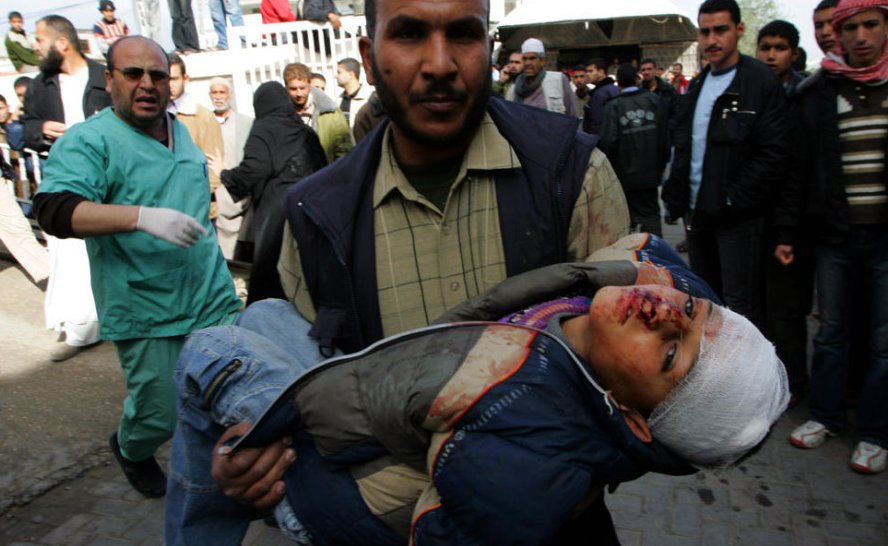
The casualties: 225 killed (including ten of children and toddlers, and still counting) and more than 700 injured, hundreds of them in critical condition. The Israeli terrorist state chose the peak hour in Gaza – while kids are returning home from school – to cause maximum death:

gaza65

gaza1

gaza47

gaza60

gaza65

gaza85

gaza86

Palestinians in the Occupied West Bank went demonstrating against the Israel terrorist crimes in Gaza and attacked Israeli terrorists with stones. Reports indicated that all fractions between political parties vanished during these demonstrations, which included Hamas and Fatah supporters who attacked Israel’s terrorist army side by side.

gaza48

gaza3

gaza36

gaza43

gaza120

gaza121

And finally, Palestinian President, Mr. Mahmoud Abbas was drinking Arabian coffee in Riyadh, Saudi Arabia. Enjoy it Mr. President!

abbas

Originally appeared at

~~~~~~~~~~~~~~~~~~


From today’s edition of The Independent


Gaza one year on: The aftermath of a tragedy

To mark the anniversary of the offensive which left hundreds of innocent civilians dead, Donald MacIntyre revisits the scene of one of the most horrifying conflicts of our time

Devastating: The Israeli attack on the town of Rafah on 13 January 2009
EPA

Devastating: The Israeli attack on the town of Rafah on 13 January 2009

Hilmi Samouni still hopes at some point – “inshallah” – to go back to his old job as a kitchen assistant in the Palmyra, Gaza City’s best known shwarma restaurant. But unlike his 22-year-old brother Khamiz, who is working once again in a car paint shop, and his 20-year-old cousin Mousa, on a two-year accountancy diploma course at Al Azhar University, Hilmi, who is 26, found that he couldn’t cope when he returned to the Palmyra after the war. “Everyone there was very supportive,” he says, “but I couldn’t do good work.” Unlike Mousa, who also lost his parents, and Khamiz, Hilmi saw the bodies not only of his father Talal and his mother Rahme but also of his wife Maha, age 20, and their only son, six-month-old Mohammed, among the 21 killed in the shelling of the warehouse in which they had been ordered by Israeli troops to gather. It still bothers Hilmi that he has no pictures of any of them; they were burnt when the family home was fired on the day before.

Now Hilmi mainly potters round the house, set amid devastated orchards and chicken coops in the southern Gaza City district of Zeitoun. The graffiti in English and Hebrew on the interior walls, left by the men of the Israeli army’s Givati brigade, are the only relics of their two-week occupation of the building – a gravestone drawn beside the words “Gaza we were here”; “One down and 999,000 to go”; “Death to Arabs”. Has the family deliberately kept the graffiti visible? “Yes, but anyway we didn’t have paint to cover them,” he says. One of Hilmi’s duties is to help look after his dauntingly self-possessed 11-year-old sister Mona, who turns the pages of artwork inspired by her memories of the morning of 5 January 2009. “This is me cleaning the face of mother who is dead. This is my father who was hit in the head and his brains came out. This is my dead sister-in-law. This is my sister taking the son from my sister in law…”

The warehouse shelling commemorated in Mona’s artwork was one of the worst of many attacks on civilians in Gaza by Israeli forces between 27 December and 18 January. The Israeli military offensive had been a long time coming but still the multiple Saturday-afternoon bombing raids with which it began came as a surprise. The stated purpose was to halt the rocket and mortar attacks – 470 of which had spread undoubted fear through the border communities of southern Israel since an Israeli raid on Hamas ended an uneasy but largely effective five-month ceasefire in early November 2008.

But if the timing was a surprise, the unprecedented ferocity of the onslaught on Hamas-controlled Gaza was even more so. More than two weeks into the war, the Israeli foreign minister Tzipi Livni would boast in a radio interview that “Israel … is a country that when you fire on its citizens it responds by going wild – and this is a good thing”. Whether, as Judge Richard Goldstone’s UN-commissioned report on Operation Cast Lead charged, Israel “targeted” the civilian population, or whether, as some soldiers have since attested, the military simply subordinated the preservation of Palestinian lives to those of its own troops, the figures tell their own story of the extent to which “a country” went “wild”. Though disputed by the military, exhaustive research by the respected Israeli human-rights agency B’Tselem put the total death toll at 1,387, of whom 773 were civilians. In the same period, four Israelis were killed in Israel by rocket fire, and nine soldiers in Gaza, four from friendly fire. Because the borders were closed, there was no flow of refugees out of Gaza of the sort that would have followed an equivalent onslaught elsewhere.

That early-morning bombardment of Wael Samouni’s half-finished warehouse – where some 100 of his extended family, including his young relative Hilmi, had been sheltering – is one of more than 20 events being investigated by the Israeli military police. Last month, pointing out that so far only one soldier has faced trial over his conduct of the war – for stealing a Palestinian’s credit card – B’Tselem complained that since the Army itself was doing its own investigating, any indictments would be directed only against “the lower echelon” and that an independent inquiry capable of attributing blame to “senior officers” and government policy-makers in the “political echelon” was needed.

Either way, there is no sign as yet of an investigation into a separate incident early the previous day, the first of the ground invasion. Israeli soldiers, their faces camouflaged in black, some with branches round their helmets, stormed into the house behind Hilmi’s home, where his uncle, Atiya Samouni, a 46-year-old farmer, was taking refuge with his two wives and 15 children.

The family say that the house’s front door had deliberately been left open so the advancing troops would see there were children inside. According to their account, Atiya, who spoke some Hebrew, walked with his hands up to the open door of the children’s room – where the family was huddled – to show himself to the soldiers who were by now in the adjacent living room. His four-year-old son Ahmad followed him, crying out “Baba, Baba” – “Daddy” – and Atiya told him: “Don’t be afraid.” But as Atiya started to speak to the soldiers he was shot dead. The troops then began shooting into the children’s room, to screams from the adults of “katan” and “ktanim” – “little one(s)” in Hebrew. Five of the children were hit; Ahmad was shot twice in the chest, fatally.

Eleven months later, the widowed Zeinat Samouni seems cheerful at first, pressing visitors with a hospitable smile to take one of the round flatbreads she is baking for the imminent Muslim festival of Eid al Adha in the one room she now shares with her seven surviving children. But she cannot stop crying as she describes how they left the house – and the body of her husband – with an older son carrying the heavily bleeding Ahmad to the house of another relative. As evening came, she gave Ahmad, his face now yellowing, bread dipped in water; “It was like feeding a bird,” she recalls. The family called an ambulance but were told that it was too dangerous for it to approach the area. Ahmad died in the early hours of Monday morning. “If we’d been able to get an ambulance, I think he would be alive now,” she says.

Zeinat’s daughter, 10-year-old Amal, carries everywhere in her pocket two worn photographs of her dead father and brother. “I want to look at them all the time,” she says, almost a year after they were killed. “My house is not beautiful without them.” Amal was also injured and says her head and right eye still hurt. But the psychological trauma for Amal is compounded by the fact that she ran off before her mother and siblings left the house after the shooting. Four days later, she was found, partly buried under rubble, dehydrated and in shock, one of 15 other survivors in the immediate area when Red Cross ambulances were finally allowed to get close enough to bring them out. At school, Amal’s favourite subjects are Arabic and English. “I don’t know much English, but I like it,” says the girl, who wants to be a doctor when she grows up.

Of Atiya’s children with his other wife, Zahawa, the most affected is Kannan, now 13, who still limps from the gunshot in his left thigh. Before the war, he was a keen midfielder but he no longer plays football. For him, too, the impact has not only been physical, however. In the months after the shooting, he had nightmares – and was several times found crying in his sleep or shouting, “They want to shoot my father”. “He won’t go to the toilet on his own,” his mother says, adding that he is easily scared – for example, by the sound of gunfire from a nearby Hamas police-training camp. Kannan, too, has a sketchbook – his drawing encouraged by the counsellor who saw him for four months after the war. It depicts the shooting of his father … children frightened of aeroplanes overhead … a destroyed Mosque.

Even for the Samounis, however, life goes on. Kannan’s family should soon be able to grow six rows of lettuces, peppers and tomatoes on a small plot of land, thanks to a Red Cross irrigation repair project – two wells were destroyed during the military occupation of Zeitoun. It’s not enough produce to sell, as they had before, but it’s a start. His cousins have also been lent an acre of land, producing olives, figs and vegetables.

Down the road, 22-year-old Rami Samouni, whose brother Hamdi was killed by Israeli forces along with the 18,000 chickens in his coop, is helping to rebuild the destroyed house of his cousin Arafat. The rebuilding is partly funded by the 4,000-euro compensation from the Hamas government earmarked for anyone who lost their home in its entirety, along with $5,000 from the rival Palestinian Authority in Ramallah, discreetly channelled by the UN Development Programme to ensure that no political stigma attaches locally to its beneficiaries. Rami, who will graduate next year with an education degree from Al Azhar University, sees the reconstruction as a metaphor. “You have to have hope. If you consider yourself sick, you’re going to be sick. You die if you don’t rebuild. Our enemies want us to give up and stop life. We have to move on.” Despite his talk of “enemies”, Rami says more than once in our conversation that he would accept a solution based on the 1967 borders, with Israel and a Palestinian state existing side-by-side.

Elsewhere, too, there is varied but pervasive evidence of the famous Gazan resilience, even where the damage is worst. A year on, there are few bleaker sights than the rubble still left by last winter’s large-scale dynamiting and bulldozing of houses in the northern Gaza districts of Abed Rabbo and Atatra. All but a small minority of those made homeless by the war are renting homes or lodging with relatives. But in Atatra, where much of the destruction occurred during the last days of the war, a few are still living in tents. It seems to be the women here who are holding things together. The house of Arifa abu Leila, the 40-year-old mother of nine children, was destroyed after the family was forced to leave by Israeli soldiers. Now, under canvas, the family has only a hosepipe and a large plastic bowl for washing. She says the family never got the 4,000 euros from the Hamas authorities and muses the reason may be because her husband “used to be in Hamas but then he left it a long time ago”. But when her husband Saleh arrives, he denies adamantly that he was ever in Hamas.

Their neighbour, 30-year-old Majda Ghabin, has a significantly more positive reason for living in a tent. With the money he received for his house – destroyed after he was forced out of it, arrested by Israeli troops, and held in Israel for five days during the war – he has rehabilitated his land and invested in carrots, cheaper to care for than the strawberries he used to farm. “I thought it was better to keep working than to find another house,” he explains. “That way I can make some money and maybe build a house in the future.”

Over in the Abed Rabbo district, east of Jabalya and closer to the Israeli border, the wreckage has even generated its own micro-economy. At 6.30 each morning, Saber Abu Freih and his 60-year-old mother Ghazala arrive at what was once their house, partly to sift – so far in vain – through the rubble to find the jewellery they left behind 11 months ago and partly to load a donkey cart with blasted masonry needed to make new breeze-blocks for small-scale construction. A day’s work may bring around 100 shekels (£16) to be shared with his six brothers. “We are clearing the land, collecting stones that will be used for building at the same time,” he says cheerfully. “We may only get 10 shekels [£1.60] a cartload. But what can we do?”

Donkey carts like this one head for the nearby Al Shobaki concrete works to be ground down and made into building blocks. Here, the owner, Abdel Salem al Shobaki, succinctly describes the business spiral of his company since the works was started during the height of the Intifada in 2003 as “excellent to good to bad to unbelievable”. The “bad to unbelievable” period, which began in mid-2007, reflects the recent political history of Gaza. Having won the 2006 electoral contest for control of the Palestinian parliament, to the consternation of just about everyone, possibly including Hamas itself, the militant Islamic faction rapidly found itself at odds, not only with Israel and the international community, which united in demanding that it recognise Israel as it had consistently failed to do, but also with the Fatah Palestinian President Mahmoud Abbas, who unlike his political co-habitants had long renounced violence and long embraced the idea of a two-state solution. Despite the mounting tensions through 2006, exacerbated by the abduction of the Israeli corporal Gilad Shalit and the ensuing military conflict, a short-lived Saudi-brokered coalition with Fatah was established in February 2007. In June of that year, however, the coalition broke down amid savage internecine fighting on Gaza’s streets which was decisively won by Hamas, who seized control in Gaza. Abbas “sacked” the Hamas prime minister Ismail Haniyeh, leaving the putative future Palestine split between the West Bank under his own control, and Gaza under that of Hamas. And Israel imposed a total economic siege which at a stroke halted Gaza’s once- vibrant manufacturing and agricultural sectors – which often exported to Israeli trading partners – by closing the borders to all but the inward passage of basic humanitarian goods. It is a policy for which Gaza’s population of 1.5m has been paying the price ever since.

Among much else, it left Mr Al Shobaki short of a crucial commodity that he used to import regularly from

Israel. Ever since June 2007, he says, he’s had “4,000 tons of gravel but no cement”. Then two months ago, Mr Al Shobaki – who says he actually pays 15-20 shekels (£2.40-£3.20) for a good cartload of war rubble – was finally able to procure enough cement to start the works going again, thanks to the tunnels through which it is smuggled from Egypt. Gazans are often sceptical about the quality of Egyptian cement – a joke doing the rounds is that a new Hamas-affiliated mosque on Gaza City’s beach road has remained uncompleted because the imams are holding out for Israeli cement. But the real problem is the price. Mr Al Shobaki pays 1,400 shekels (£220) a ton for Egyptian cement through the tunnels – compared to the 380 shekels (£60) or so he paid when the crossings were open and it came from Israel. “First I’d like to see reconciliation between Fatah and Hamas,” he says, “and then I’d like to see the crossings open. Anyone who says that the Israeli economy and Gaza’s are not connected is stupid. They are one economy.” Nevertheless, the tunnels have allowed him to restart production – though at next-to-no profit. For most Gazans, they are now the only tangible contact with the outside world.

A large tent city stretches along Gaza’s southern border in Rafah, on the old Philadelphi Road which until 2005 was the Israeli-controlled no-man’s land between Egypt and Gaza. Overlooked by the watchtowers of Egyptian security rising above the border fence on the south side and the apartment blocks raddled by Israeli shelling from the years of the Intifada on the Palestinian side, the tents protect the entrances to hundreds of smuggling tunnels. These tunnels have served as Gaza’s lifeline since June 2007 – and have continued to do so despite the almost-daily Israeli bombing raids during Operation Cast Lead and the 117 deaths of workers, mostly from natural tunnel collapses, in the past year. Now the tunnels are among the Israeli Air Force’s retaliatory targets of choice every time a Qassam rocket is launched into southern Israel in breach of the undeclared but – most of the time – effective ceasefire.

Today, as the late-November sun sets over the Mediterranean to the west and a solitary F16 flies high overhead, an earthmover has been at work for several hours beginning the repairs to a tunnel entrance destroyed that morning. Surveying the wreckage, tunnel worker Abu Yusef recalls that he once earned 300 shekels (£48) a day as a gardener in Israel when the crossings were open, and would willingly do so again rather than risk his life for a third of that. “If there was other work, I wouldn’t look at a tunnel again,” he says.

One of the wrecked tunnel’s owners, who answers only to the name of Abu Hassan, estimates that it will cost almost £40,000 to repair the tunnel but it will – eventually – be worth it. Reeling off the goods he transports through the tunnels – “clothes and food, Galaxy chocolate, empty cola bottles, biscuits” – he acknowledges: “It will take me five months to cover the repair costs – before I would have done it in a month.” For business is down, largely because the market is saturated by the tunnels themselves. Supervising the arrival of a bamboo consignment and explaining that his tunnel also handles “clothes and sheep”, Mohammed, a 27-year-old from Khan Younis, says “it’s not like it used to be – there are a lot of products in Gaza. Gaza is full of bamboo.”

Every diplomat familiar with the area believes that Hamas is actually benefiting from the tunnel economy created by the siege. It’s not just the 10,000 shekels (£1,600) each operator has to pay the Hamas-controlled Rafah municipality, ostensibly for “regulation and health and safety” – but which has not prevented 32 children and young people under the age of 18 being killed in the tunnels this year. One prominent Gaza businessman says that Hamas also brings in consumer goods through its own secret tunnels – the ones Israel believes it uses to import weapons – and then enlists tame traders to distribute the goods and share the profits with the faction. All of which can only make a mockery of the idea that the Israeli-imposed blockade hurts Hamas rather than the civilian population.

Thanks to the tunnels, the shops are fuller than at any time since June 2007, probably making the gift exchanges at this year’s Muslim festival of Eid al Adha a little cheerier than last year, with plentiful Egyptian goods – at least for those who can afford to buy. A good imported box of chocolates costs around 150 shekels (£24) compared with just 60 shekels (£10) when it came from Israel, a sweater three times its old price of 50 shekels (£8). But this year’s Eid also signified something else: a deep reluctance on the part of many Gazans to wallow in their post-war grief and loss. True, a livestock trader in Jabalya estimated that only 35 per cent of Gazan families would be able to afford one of the traditional sheep for Eid – Sudanese, Libyan or Egyptian this year because imported through the tunnels. But in the vibrant pink feathers and the cloth flowers sported in the hair by perfectly turned-out little girls in the ruins of Atatra, or the parties of young middle-class Gazan women – their heads stylishly covered – crowded into the fashionable seafront Al Deira hotel, you could see a determination to make the best of the festival.

The celebratory mood was certainly reinforced by the hope of an imminent prisoner exchange for the release of Gilad Shalit – and the prospect, whether bankable or not, that it would be followed by Israel’s at-least-partial lifting of the siege. But what neither the Eid celebrations nor the constant if costly flow of consumer goods through the tunnels can disguise, however, is the scale and impact of Gaza’s de-development. Jadwat Khoudary, one of Gaza’s most prominent businessmen, points out that even in “normal” times – without the present dire need for massive post-war reconstruction – Gaza’s daily requirement was for around 1,500 tons of cement. The expensive cement coming through the tunnels amounts to around 150 tons, enough for a relatively few individual families to repair their war-damaged homes. And he gives a striking example of Gaza’s Alice in Wonderland economics from one of his companies, which unlike many hundreds of others has – just – managed to keep going. It used to manufacture flexible foam, used in mass-produced cushions. But because the chemical raw materials are no longer available from Israel, the firm is now producing just 5 per cent of what it did, cutting and shaping ready-made flexible foam imported through the tunnels. He has laid off more than 200 workers; most of those who found jobs went “either to the Hamas internal police, the [regular] police, the [Hamas-run] Ministry of Works or muncipalities belonging to Hamas. How can I blame them if I cannot pay them salaries?” he says.

We are talking on the eve of the Eid in his popular – but now, in the late afternoon, empty – beachfront restaurant. “Why do you think there’s no one here?” he asks. “Because most people are fasting before the Eid. Twenty years ago, only 1 per cent would have done that. Now it’s about 90 per cent.” Although Hamas had issued no edicts on this issue, Khoudary believes the phenomenon results from messages handed down from the mosques since Hamas came to power. He sees this, and the similar turn-round in those going to the Mosque to pray regularly, as evidence of the Islamic Hamas’s “credibility in the street” – one which the winter war of 2008-09 has done nothing to diminish.

Certainly you can see the weakening of secularism on Gaza’s streets. More women are covering their heads; there is a greater sprinkling of them wearing the once rarely-seen nakab, the garment covering the whole face except for the eyes. And the greatest internal pressure on Hamas is not Fatah, which has been effectively repressed in Gaza, but from more extreme Islamist groups. To Khoudary, these developments are the function of what he calls “a mental siege” in which lack of contact with the outside world is turning Gaza inwards. To take a single example, there has been a complete halt to the once-steady flow of many hundreds of students a year, often to pursue postgraduate studies, abroad or in Israeli universities. Now Israel has used the closure to stop students even travelling to the West Bank, let alone to Israel or foreign countries. Thanks to the tunnels, says Khoudary, and provided you can afford it, “you can order anything you want in 36 hours. But the mental siege is the most dangerous and harmful siege.” He asks why Israel fosters a climate which in the long run will encourage extremist groups “worse than the Taliban”. “Israel is so stupid,” he says. “They are punishing the wrong people.”

No one here has done more to try to ease this “mental siege”, within the constraints of total closure, than John Ging, the UN Relief and Works Agency (UNWRA) director of operations and the man responsible for the education and welfare of Gaza’s almost one million refugees. Ging, a former Irish Army officer, is a brave man; he was at the UNRWA headquarters when its warehouse was destroyed under Israeli white-phosphorus shelling attack during the third week of Operation Cast Lead. In March 2007, when lawlessness in Gaza was at a peak from which it has now declined thanks to Hamas policing, Ging’s UN convoy was ambushed and 18 bullets fired into his armoured vehicle by Palestinian gunmen seeking to abduct him. Two months later, one of his bodyguards was injured when a UN school he was visiting came under fire. Even more extreme elements within Hamas – though never the de facto Hamas government itself – have issued threatening critiques of the highly successful summer games UNRWA ran for 250,000 children, of Ging’s warning to UNRWA’s Palestinian staff to leave their politics at the door when they come to work, and – most recently – of his bold determination to include holocaust studies in the UNRWA school human-rights curriculum.

Yet what gives Ging his high credibility in Gaza is his tireless championing of the civilian population in the face of what he repeatedly calls the “failed and flawed” policies of isolating it. The end of the war, he says, left Gazans “worse than before” because of the “unfulfilled hope” that it would also mark the end of “that era of collective punishment … that had been their daily life for so long”. For the war had at least finally generated an international realisation “that it was the civilian population that was paying a devastating price not only in loss of life but [also] in their living conditions”.

But rather than an end to isolation, Ging says, the traumatised Gazans have seen that “daily life continues to deteriorate and, as they listen and they read of more talk of war, they see the peace process is in further peril”.

Ging acknowledges that this is not a “typical human emergency” made visible by “emaciated bodies and an overwhelmed medical service” – though he points out that 80 per cent of Gazans are dependent on food aid, that the medical services are overloaded but somehow coping, and that the water and sewage infrastructure is on the brink of crisis with 80m cubic litres of raw sewage pumped daily into the Mediterranean, 80 per cent of the drinking water below WHO minimum standards and 60 per cent of people with only irregular access to water. Instead, he says, “the problem here is the destruction of a civilised society and what the impact of that will be for the solution to this conflict”.

As a man for whom belief in international law is a driving passion, he has sought to combat this trend with a human-rights curriculum in UN schools which is anything but routine, less than a year after a war about which the Goldstone report accused mainly Israel but also Hamas of war crimes. Ging is convinced about the positive response of Gazan civilians. “You only have to talk to them,” he argues, to know that “they are not terrorists, they are not violent people. They are deeply civilised people … not withstanding the provocative nature and injustice of their circumstances.”

Their aspirations are not, he says, “vengeance or revenge or violence or destruction – their aspirations are the same as any civilised person on this planet. They want the space to live, basic fundamental freedoms of human rights. They understand the difference between right and wrong and sanctions against those who are in violation of the law, but their claim – which I fully support – is that the innocent should not be sanctioned.”

Like Jadwat Khoudary, Ging is fearful however of the extremism that the “devastatingly” negative conditions of Gaza threaten to breed, including among school pupils. “How do we motivate them to achieve their academic potential when their mothers and fathers, brothers and sisters have no job and no prospect of a job? They listen every day to rhetoric, very destructive, which capitalises on their physical experience which is very negative – and tries to attach that to violent activity as being the way out of those circumstances.” UNRWA, says Ging, aims to counter that through education. But, he adds, “the most important support is to change the circumstances”.

The UN Girls’ Preparatory School A in Zeitoun, the very neighbourhood where calamity overtook the Samouni family, helps to illustrate the point. Three of its pupils were killed during the war, 25 injured and many more were made homeless by the destruction. Late last month, it staged a varied day of activities to reinforce another Ging initiative – one that perhaps would not go amiss in many British schools – the Respect and Discipline programme. They ranged from a parade – “We call it ‘military’ because we want the discipline of soldiers without the violence,” explained teacher Soha Sohoor – to a playlet set in court in which teenage girls acted the parts of a female lawyer, teacher, doctor, engineer and housewife successfully defending themselves against a judge’s draconian anti-woman ruling. Afterwards, four articulate 14-year-olds discussed issues ranging from domestic violence and the impact of the winter war to the determination of all four to go to university. All said they favoured a two-state solution based on 1967 borders.

Shaima Remlawi, who is learning English, wants to be an international interpreter but also sees herself campaigning for women’s rights – particularly against early marriage and fathers who discourage their daughters from completing their education. “I will not marry until I am more than 20,” she declared. Afrian Naim wants to be a journalist, “so I can give the message of the Palestinians all over the world.” Islam Aqel wants to become both a professor and a “novelist who can write books that everyone can read.” And Ahlam Al-Haj Ahmed said: “I want to be a journalist writing about the sufferings of the Palestinian people. But I want to be effective in society, to be a member of the PLC [the Palestinian Parliament], not in Fatah or Hamas but as an independent, so I can tell the others when they are doing well and when they are not doing well.” It’s hard not to be impressed with these girls, brimming with healthy ambition. But hard also not to wonder – without that “change in circumstances”, an end to Gaza’s siege, mental and physical – how long it will be before their dreams crash into irrevocable disappointment.

“It’s urgent that we change,” says Ging. “Because time is against us. A whole generation is growing up.”

PALESTINIAN CHRISTIANS CAMPAIGN TO ISOLATE ISRAEL

Palestinian Christians Urge Israel Isolation

By Khalid Amayreh

“Apartheid can’t be wrong in South Africa and right in occupied Palestine,” Kassis told IOL.

BETHLEHEM — Christian religious and community leaders in occupied Palestine have launched an ecumenical campaign aimed at enlisting Christians around the world to help end the Israeli military occupation.”This document is the Christian Palestinians’ word to the world about what is happening in Palestine,” says the 15-page document.

“We, Palestinian Christians, declare in this historic document that the military occupation of our land is a sin against God and humanity and that any theology that legitimizes the occupation is far from Christian teachings because true Christian theology is a theology of love and solidarity with the oppressed and a call to justice and equality among peoples.”

Initiators, who include leaders of major churches in the Holy Land, said they had been working on the document for over a year.

“We have not encountered any real opposition to the document,” Rifat Kassis, the main spokesman of the initiative, told IslamOnline.net.

He expects as many as 32 Christian institutions, 200 community leaders as well as thousands of intellectuals and intelligentsia to sign the document, themed Kairos Paletine-2009: A Moment of Truth-A word of Truth, Hope, and Love from the Heart of Palestinian suffering.


“In fact, all religious leaders are backing the initiative wholeheartedly. Even some evangelical leaders are endorsing the document.”

Palestinian Christian leaders say the situation in occupied Palestine has reached “the moment of truth,” or Kairos as the concept is called in Christian theological lexicon.

“The decision-makers content themselves with managing the crisis rather than committing themselves to the serious task of finding a way to resolve it,” says the document.

“The problem is not just a political one. It is a policy in which human beings are destroyed, and this must be of concern to the Church.”

Ugly Reality

The document describes an extremely ugly reality in occupied Palestine under the yoke of the Israeli occupation.

It lists the various numerous disastrous effects of the occupation on Palestinian daily lives, including the separation wall, continued Jewish settlement expansion and the daily humiliation of Palestinians at military checkpoints.

“Religious liberty is severely restricted; the freedom of access to the holy places is denied under the pretext of security,” it says.

“Jerusalem and its holy places are out of bounds for many Christians and Muslims from the West Bank and the Gaza Strip.

“Even Jerusalemites face restrictions during the religious feasts. Some of our Arab clergy are regularly barred from entering Jerusalem.”

Israel captured and occupied Al-Quds in the six-day 1967 war, then annexed it in a move not recognized by the world community or UN resolutions.

The city is home to some of the holiest Christian worship places including the ancient Jerusalem Church and Greek Orthodox Church.

Al-Quds is also home to Al-Haram Al-Sharif, which includes Islam’s third holiest shrine Al-Aqsa Mosque, and represents the heart of the Arab-Israeli conflict.

Since its occupation, Israel has adopted a series of oppressive measures to force the Palestinian inhabitants of Al-Quds out, including systematic demolition of their homes.

“The shrinking number of Christians, particularly in Palestine, is one of the dangerous consequences, both of this conflict, and of the local international paralysis and failure to find a comprehensive solution to the problem,” says the document.

“Thus the land is deprived of its most important and richest resource-educated youth.”

World Support

The document is being symbolically signed by dozens of Christian leaders in the West Bank, Al-Quds (occupied East Jerusalem) and the rest of occupied Palestine.

The symbolic signing, which started on Friday, December 11, will last for a few weeks.

Then special emissaries, mostly clergymen, will carry the landmark document to churches in Europe and North America for endorsement and adoption.

Initiators said they hoped that the document would raise the conscience of Christians in the West and around the world to end the Palestinian plight.

Some church leaders have described it as an impassioned appeal or an SOS to Christians worldwide to stand on the side of justice in Palestine.

“We are a peaceable people, we are not terrorists if only because we are the victims of terror, we love freedom, we love justice, we love our country, we love our Jerusalem and we insist on living with human dignity,” says Archbishop Atallah Hanna, a prominent leader of the Orthodox Church of Jerusalem and one of the initiators.

“This is why we feel Christians worldwide have a paramount religious and human duty to stand on our side. This is a moral and human responsibility that Churches and Christians in general must not flinch from pursuing.”

Kassis, the spokesman, said local Christian leaders had been coordinating the initiative with the World Council of churches and other Christian bodies around the world.

“Ultimately, we hope that Christian institutions, including churches around the world, will endorse this document and act on it the same way churches related to the anti-apartheid South African regime back in 1985,” he told IOL.

In 1985, a group of black South African theologians based predominantly in the black townships of Soweto issued a theological statement challenging the churches’ response to the vicious policies of the apartheid regime.

The Kairos Document evoked strong reactions and furious debates world-wide.

“In the final analysis, apartheid can’t be wrong in South Africa and right in occupied Palestine,” says Kassis.

Archbishop Hanna, an outspoken critic of Israeli occupation and apartheid, believes the unbearable situation in occupied Palestine must come to an end.

“Everything has a beginning and an end. The Israeli occupation must have an end, and the end must come now.”

~~~~~~~~~~~~~~~~~~~~~~~~~~~~~~~

From Mazin Qumsayeh …..

Full text of the Kairos Palestine Document:

In English
http://www.oikoumene.org/fileadmin/files/wcc-main/2009pdfs/Kairos Palestine_En.pdf

In Arabic
http://www.oikoumene.org/fileadmin/files/wcc-main/2009pdfs/Kairos Palestine_Ar.pdf

Auf Deutsch
http://www.oikoumene.org/fileadmin/files/wcc-main/2009pdfs/Kairos Palestine_Ger.pdf

En français
http://www.oikoumene.org/fileadmin/files/wcc-main/2009pdfs/Kairos Palestine_Fr.pdf

For the list of signatories:
http://kairospalestine.ps/?q=node/2

Churches in the Middle East: solidarity and witness for peace:
http://www.oikoumene.org/?id=3113

Additional information: Juan Michel,+41 22 791 6153 +41 79 507 6363 media@wcc-coe.org
The World Council of Churches promotes Christian unity in faith, witness and service for a just and peaceful world. An ecumenical fellowship of churches founded in 1948, today the WCC brings together 349 Protestant, Orthodox, Anglican and other churches representing more than 560 million Christians in over 110 countries, and works cooperatively with the Roman Catholic Church. The WCC general secretary is Rev. Dr Samuel Kobia, from the Methodist Church in Kenya. Headquarters: Geneva, Switzerland.

=====================

And From Ecumenical News International (Switzerland); www.eni.ch
Israeli occupation a ’sin against God’, say Palestinian Christian leaders

Jerusalem (ENI). Palestinian Christian leaders have issued a call for an end to Israeli occupation of Palestinian territory, which they described as, “a sin against God and against humanity,” and have appealed for support from the world’s churches.

“The injustice against the Palestinian people, which is the Israeli occupation, is an evil that must be resisted,” the Christian leaders said in a document that was almost two years in the making. “Resistance is a right and a duty for the Christian. But it is resistance with love as its logic,” they said. “It is thus a creative resistance, for it must find human ways that engage the humanity of the enemy.”

The initiators of the statement, made public at an 11 December meeting in Bethlehem, have referred to the text as the “Kairos Palestine” document. “Kairos” is a Greek word used in the Bible for a God-given time of challenge, grace and opportunity.

The organizers said that their statement echoes the Kairos document that South African churches issued in the mid-1980s, and which helped galvanise churches and the wider public in a concerted effort that eventually led to the end of apartheid.

“It is a call to the international community worldwide to look at the plight of the Palestinians and put pressure on Israel to conform to international law,” spokesperson and coordinator Rifat Kassis told Ecumenical News International.

“Despite the talk about peace and the peace process conducted for 17 years, nothing has happened and the situation continues deteriorating,” Kassis said. “It is the right time for a more ethical perspective on the conflict, and that should come from religious leaders.”

The full title of the document is, “A moment of truth: A word of faith, hope and love from the heart of Palestinian suffering”.

Signatories include the former leader of the Roman Catholic Church in the region, Latin Patriarch emeritus Michel Sabbah; the Lutheran bishop of Jerusalem Munib Younan; and Archbishop Theodosios Atallah Hanna of Sebastia from the Greek Orthodox Patriarchate of Jerusalem.

“The aim is to free both peoples [Israelis and Palestinians] from extremist positions of the different Israeli governments, bringing both to justice and reconciliation,” the Palestinian Christian leaders stated. “In this spirit and with this dedication, we will eventually reach the longed-for resolution to our problems, as indeed happened in South Africa and with many other liberation movements in the world.”
The signatories accused Israel of “disregard of international law and international resolutions”. Issues faced by Palestinians, they said, included the “separation wall” that cuts through Palestinian territories, Israeli settlements and “daily humiliation” at military checkpoints.

Rejecting Israeli justification for Israel’s actions being in self-defence, the Palestinian Christian leaders said, “There would be no resistance, no fear and no insecurity” if there were no occupation.

“The Israeli occupation of Palestinian land is a sin against God and humanity,” the Palestinian Christian leaders stated, “because it deprives the Palestinians of their basic human rights, bestowed by God. It distorts the image of God in the Israeli who has become an occupier, just as it distorts this image in the Palestinian living under occupation.”

The initiative brought together leaders of most Palestinian Christian denominations and prominent Christian theologians, said Kassis.

The Geneva-based World Council of Churches helped facilitate the formation of the document, which also addresses churches worldwide including WCC members who may have differing views of the Israeli-Palestinian conflict.

The signatories, acknowledging that they are small in number, said their message was, “great and important” not only to Christians but also to Muslims and Jews. To their Muslim neighbours, they sent a “message of love and of living together,” while at the same time urging them to reject fanaticism and extremism. They also called on the world to reject uninformed views of Muslims so that they were not, “stereotyped as the enemy nor caricatured as terrorists”. To their Jewish neighbours, the signatories affirmed the possibility of a shared life despite past struggles.

The Christian leaders condemned all forms of racism including anti-Semitism and Islamophobia, and called on Christians world wide to, “say a word of truth and to take a position of truth with regard to Israel’s occupation of Palestinian land”.

The writers also urged churches around the world, “not to offer a theological cover up for the injustice we suffer, for the sin of the occupation imposed on us”.

Kairos Palestine document: www.oikoumene.org/fileadmin/files/wcc-main/2009pdfs/Kairos%20Palestine_En.pdf
Kairos Palestine website: www.kairospalestine.ps

Israeli Occupation, Colonialism And Apartheid


The Cape Town, South Africa-based Human Sciences Research Council (HSRC) “conduct(s) large-scale, policy-relevant, social-scientific projects for public-sector users, non-governmental organisations and international development agencies,” and disseminates its findings widely.

In May 2009, it issued a damning report titled, “Occupation, Colonialism, Apartheid? A re-assessment of Israel’s practices in the occupied Palestinian territories under international law.” At the time John Dugard was the UN’s Special Human Rights Rapporteur for Occupied Palestine. At his January 2007 suggestion, the study was undertaken “to scrutinise (his) hypothesis from the perspective of international law.”

It stated: “Israel is clearly in military occupation of the OPT (Occupied Palestinian Territories). At the same time, elements of the occupation constitute forms of colonialism and of apartheid, which are contrary to international law. What are the legal consequences of a regime of prolonged occupation with features of colonialism and apartheid for the occupied people, the Occupying Power and third States?”

Given South Africa’s past, the HSRC had an “obvious interest” in pursuing these issues. After 15 months of research, its report concluded that:

“….Israel, since 1967, has been the belligerent Occupying Power in the OPT, and that its occupation of these territories has become a colonial enterprise, which implements a system of apartheid.”

Although occupation is legal after armed conflict, it’s intended only to be temporary. International law also prohibits the unilateral annexation or permanent acquisition of territory through force, and Fourth Geneva obligates signatories to protect civilians in time of war and occupation.

Its Article 3 states:

“Persons taking no active part in the hostilities, including members of armed forces who have laid down their arms and those placed hors de combat (out of the fight) by sickness, wounds, detention, or any other cause, shall in all circumstances be treated humanely, without any adverse distinction founded on race, colour, religion or faith, sex, birth or wealth, or any other similar criteria.”

Its Article 4 defines “protected persons” as follows:

“Persons protected by the Convention are those who, at a given moment and in any manner whatsoever, find themselves, in case of conflict or occupation, in the hands of a Party to the conflict or Occupying Power of which they are not nationals.”

Its Article 49 states:

“Individual or mass forcible transfers, as well as deportations of protected persons from occupied territory to the territory of the Occupying Power or to that of any other country, occupied or not, are prohibited, regardless of their motive.” Neither shall “The Occupying Power….deport or transfer parts of its own civilian population into the territory it occupies.”

In addition, numerous UN resolutions established “no legal validity” for occupied land acquisitions or settlement building. When violations of international law occur, no nation may recognize or support the unlawful situation or the state responsible.

In addition, colonialism and apartheid are particularly serious international law breaches because they fundamentally violate core legal order standards and values. The International Court of Justice (ICJ) affirmed self-determination as “one of the essential principles of contemporary international law,” obligating all states to respect and promote it. Colonialism is in clear violation.

The 1960 Declaration on the Granting of Independence to Colonial Countries and Peoples (the Declaration on Colonialism), condems “colonialism in all its forms and manifestations,” including settlements deemed to be illegal.

According to the 1973 International Convention for the Suppression and Punishment of the Crime of Apartheid (the Apartheid Convention), this practice is state-sanctioned discriminatory “inhuman” racism “committed for the purpose of establishing and maintaining domination by one racial group of persons over any other racial group of persons and systematically oppressing them.”

Apartheid is an international crime. The above definition builds on the 1965 International Convention on the Elimination of All Forms of Racial Discrimination (ICERD). In addition, the 1998 Rome Statute of the International Criminal Court calls apartheid a crime under the Court’s jurisdiction. Israel is flagrantly guilty but not yet held accountable.

International laws prohibiting colonialism and apartheid are “peremptory,” meaning they are “accepted and recognized by the international community of States as a whole as (standards) from which no derogation is permitted.” Every country is legally bound to respect and observe them. They’re also duty bound to:

– work cooperatively to end individual state violations;

– not extend recognition to lawless ones; nor

– provide them aid in any form.

Legal Framework in the OPT

Applicable international law recognizes:

– the Palestinians’ right to self-determination;

– the fact that Gaza, the West Bank and East Jerusalem are illegally occupied;

– that Israel has no sovereignty over these Territories, only an earlier temporary administrative right no longer applicable;

– that land seizures are illegal; so is the Separation Wall as the ICJ affirmed in 2004;

– that the 2005 Gaza “disengagement” left Israel in control; and

– that, as an Occupying Power, international law obligates Israel to “abide by the….rules of armed conflict (and relevant human rights laws) in its administration of the territories.”

For over 42 years, Israel willfully violated the law under a dual discriminatory regime. Its occupation and land seizures are illegal. Its settlers are protected under civil laws assuring them free movement and essential services. Palestinians come under military law and its courts with procedures that violate international judiciary standards. Israel’s High Court affirmed the bifurcated system that “discriminate(s) between these two groups by according (them) very different rights, protections, and life chances in the same territory.” This system violates the laws of armed conflict, and also the international legal colonialism and apartheid prohibitions.

Under the Declaration on Colonialism, this practice exists when states annex or otherwise lawlessly retain territorial control and deny indigenous peoples their right to self-determination. Israel does it six ways by:

– violating the integrity of the Occupied Territories:

– prohibiting meaningful self-government;

– integrating the area’s economy into its own;

– controlling its resources;

– denying the population economic enfranchisement, free movement, expression, its historical heritage, their right to develop and practice it, and equal justice under the law; and

– maintaining a 42-year state of war, including killings, targeted assassinations, mass arrests, incarcerations, torture and abuse, and other degrading and humiliating treatment.

Under ICERD’s Article 3, apartheid is prohibited as a particularly egregious form of discrimination, without precisely defining the practice. The Apartheid Convention and Rome Statute went further with a better one and by criminalizing certain apartheid-related acts – specifically, “inhuman (ones) committed for the purpose of establishing and maintaining domination by one racial group of persons over any other and systematically oppressing them.”

Both focus on systematic, institutionalized discrimination to achieve racial segregation and unchallenged dominance. Under the Apartheid Convention’s Article 2, HSRC determined that:

– Israeli measures deprive Palestinians of their right to “life and liberty of person;”

– they include state-sponsored violence; killings; extrajudicial assassinations; arbitrary arrests and incarcerations; torture and abuse; other cruel, inhuman or degrading treatment; kangaroo court justice in military tribunals; and administrative detentions without charge, adequate access to counsel, trial, or proper judicial review;

– state-sponsored collective punishment seriously impairing life and health, especially in Gaza under siege;

– Palestinians have no free and equal participation in their political, social, economic and cultural lives;

– they’re also denied their basic human rights and freedoms with regard to free movement; their right of return; to live anywhere in historic Palestine freely in the land of their birth; and to a nationality through self-determination;

– they’re denied economic self-determination and their right to work anywhere in historic Palestine;

– their trade unions aren’t recognized so they can’t represent Palestinians effectively;

– under military occupation, their right to education, medical care and other essential services is seriously impaired;

– censorship laws restrict free expression and opinion;

– military orders deny free assembly and public gatherings of 10 or more persons without express permission; non-violent gatherings are regularly suppressed with live ammunition, rubber-coated steel bullets, tear gas, and various other weapons;

– most Palestinian parties are considered illegal; charities, cultural organizations and other institutions and agencies connected to them are subjected to closure and attack;

– home and community intrusions, beatings, arrests, and killings occur regularly; and

– all of these practices occur in extreme form in Gaza under siege, the one difference being Jewish settlers no longer reside there, but, at any time, Israel may decide to return them and displace Palestinians by so doing.

The West Bank, in contrast, is balkanized into cantons and enclaves in which group identity determines residence and free entry. Jews have the choicest parts and keep expanding them, leaving Palestinians shrinking amounts of the rest.

HSRC’s report concluded that Israeli occupation, colonialism and apartheid are “systematic and comprehensive, as the exercise of the Palestinian population’s right to self-determination has been frustrated in all of its principal modes of expression.”

Comparing Israeli and South African Apartheid

Despite differences, Israeli and South African apartheid practices are defined by similar dominant features. Three legislative pillars underpinned South Africa’s:

– the first demarcated people into racial groups through the 1950 Population Registration Act; it institutionalized racial discrimination by affording special rights, privileges and services to whites and denied them to blacks;

– the second segregated people by geographic areas, allocated by law to different racial groups; it restricted passage from assigned areas to others to insure white supremacy; overall, it constituted “grand apartheid” by establishing “Homelands” or “Bantustans” in which “denationalized” blacks were transferred and forced to reside, while whites got special political rights denied blacks;

– the third was a matrix of draconian security laws and policies, employed to suppress opposition and reinforce racial domination “by providing for administrative detention, torture, censorship, banning, and assassination.”

In the OPT, Israel has the same three pillars:

The first legally establishes Jewish identity and affords preferential legal status and material benefits to Jews alone. Palestinians are discriminated against as inferior by religion, ethnicity, and subsequent social status.

Israel’s citizenship laws underpin the system under which Jews anywhere in the world automatically qualify for citizenship in an exclusive Jewish state. The 1950 Law of Return defines Jewishness and begins saying:

“Every Jew has the right to immigrate to this country.”

The 1952 Citizenship Law granted automatic citizenship to Jewish immigrants, while denying non-Jews similar rights. The 2003 Citizenship and Entry into Israel Law banned Palestinian family unification, giving Jews alone special rights.

The second pillar reflects Israel’s policy to expropriate choice land, segregate and dominate. It plays out through separating East Jerusalem from the rest of the West Bank, seizing increasing amounts of it for settlement development, and separating Palestinians by means of walls, barriers, checkpoints, separate roads, a discriminatory permit and ID system, and a militarized matrix of control.

In contrast, Jews have free movement and freedom. The “geographic fragmentation has the effect of crushing Palestinian socio-economic life, securing Palestinian vulnerability to Israeli economic dominance, and of enforcing a rigid segregation of Palestinian and Jewish populations,” similar to South African apartheid.

The third pillar is Israel’s “invocation of security” to justify sweeping restrictions on Palestinian free expression, opinion, assembly, association and movement and enforce them through suppression of dissent, conflict, state-sponsored violence, extrajudicial killings, arbitrary arrests and incarcerations, torture and abuse, and other kinds of cruel, inhuman and degrading treatment.

In sum, these policies are “integrated and complementary elements of an institutionalised and oppressive system of Israeli domination and oppression over Palestinians as a group; that is, a system of apartheid,” under which Israeli repression is harsh, discriminatory, and illegal under international law.

Although Israel bares primary responsibility, the international community must act cooperatively to remedy the situation as follows:

– require Israel start dismantling the structures and institutions of occupation, colonialism and apartheid;

– have it pay reparations for decades of lawlessness; and

– assure Palestinians can exercise their right of self-determination or have equal rights as citizens in one Israeli/Palestinian state.

“The realisation of self-determination and the prohibition on apartheid are peremptory norms of international law from which no derogation is permitted.” These principles obligate the entire world community to cooperate to end all breaches everywhere, including in Occupied Palestine. Failure to do so constitutes “an internationally wrongful act.” Further, any state aiding another’s lawlessness axiomatically becomes complicit in the commission of crimes, requiring other nations to hold it accountable.

International organizations like the UN bear equal responsibility. As the ICJ stated in its Separation Wall ruling, this body is obligated to resolve the Israeli-Palestinian conflict, one it helped initiate through its 1947 partition plan under UN General Assembly Resolution 181. At a time Jews comprised one-third of the population, it gave them 56% of the choicest land, the rest to Palestinians with Jerusalem designated an international city.

HSRC and John Dugard urged the ICJ to rule on this matter in accordance with the UN Charter’s Article 96 authorizing “The General Assembly or the Security Council (to) request (an ICJ) advisory opinion on any legal question.” Under Article 65 of the ICJ’s Statute, it “may give an advisory opinion on any legal question at the request of whatever body may be authorized by or in accordance with the Charter of the United Nations to make such a request.”

According to HSRC, at issue is the following:

“Do the policies and practices of Israel within the (OPT) violate the norms prohibiting apartheid and colonialism; and, if so, what are the legal consequences arising from Israel’s policies and practices, considering the rules and principles of international law, including the International Convention on the Elimination of all forms of Racial Discrimination, the International Convention on the Suppression and Punishment of the Crime of Apartheid, the Declaration on the Granting of Independence to Colonial Countries and Peoples, UN General Assembly (1960) Resolution 1514 (on granting independence to colonial countries and peoples), and other relevant Security Council and General Assembly resolutions?”

After 61 years of displacement and 42 years of occupation, these matter remain unresolved.

Notes/Sources:

The article, as written by Stephen Lendma, can be found at The Palestinian Telegraph entitled: “Israeli Occupation, Colonialism and Apartheid”

Wednesday, December 9, 2009

ANOTHER WALL THAT MUST FALL


Even before it’s completed…. IT MUST FALL!
The reasons Netanyahu (see report below) gives for construction of the proposed wall are nothing but LIES!

The wall is to guarantee the further imprisonment of the people of Gaza…. no other reason.

The crossings into Egypt are the only ways out of the existing prison camp.

Israeli Defense Minister Ehud Barak at least lied in a more diplomatic manner when discussing the situation, as can be seen in THIS report.

From the report….. The two pieces of the fence slated to be built cover 70 kilometers of the Nitzana region from Be’erotayim in the south to Rafah in the north, and 15 kilometers directly paralleling and just north of Eilat – two areas viewed as particularly attractive to border infiltrators.
Rafah in the north???? Rafah is on the Egyptian/Israeli border???? Palestine obviously does not/nor will ever exist as far as Israel is concerned.

The motives are obvious…. and THE WALL MUST FALL!

Netanyahu okays Israel-Egypt border wall

Bethlehem – Israeli Prime Minister Benjamin Netanyahu has approved the construction of a wall along the border between Israel and Egypt, Israeli media reported on Tuesday.

The decision came, according to Israeli daily Ma’ariv, after consultations involving security, political, and financial officials in Israel. Netanyahu believes construction of a barrier will stop smuggling and the migration of Africans seeking work or asylum in Israel.

The decision, according to Ma’ariv, was made as a result of an increase in the number of African immigrants crossing into Israel.

“The only place in the world where it takes tens of meters walk to cross from the third world to the first world is Israel’s southern borders,” Netanyahu was quoted as saying in the report.

According to Ma’ariv, the plans for the border wall will be ready in early summer, and there is more than one option for the nature of proposed barrier. The Israeli Defense Ministry submitted a five billion-shekel (1.3 billion US dollar) proposal to build a wall similar to the separation wall being built around the West Bank.

Ma’ariv reports that another option, suggested by Israeli Ministry of Finance, is erection of an electronic fence at a cost of 450 million NIS. Meanwhile, Israeli ministry of internal security suggested a mix of both suggestions.

Ma’ariv added that model sections of the suggested walls would be built to test their efficiency on the ground.

Also on Tuesday, Egyptian police shot and critically wounded an Eritrean immigrant on Monday evening while he attempted to cross into Israel on the Sinai desert border.

Egyptian security sources told Ma’an that the man was injured during an exchange of fire between Egyptian border police and traffickers hired to smuggle migrants into Israel.

At least 17 migrants have been killed at the border since May.


New Israeli War Doctrine Targets Civilians

New Israeli War Doctrine Targets Civilians

6g3ncr6The Public Committee Against Torture in Israel (PCATI) released,on December 2nd 2009, a new report which exposes the shifts in Israel’s combat doctrine as evidenced in the prosecution of operation “Cast Lead” and from numerous public oral and written statements made by high ranking military officers and senior Israeli government officials.

The report, “No Second Thoughts: Changes in the IDF’s Combat Doctrine In Light Of Operation ‘Cast Lead’,” demonstrates Israel’s application of a new combat doctrine during the hostilities in Gaza, which is based on two principles:

“Zero Casualties”:

The complete prioritization of avoiding IDF [Israeli army] casualties while disregarding the increased risk to Palestinian civilians. The implementation of this policy is evident in the massive use of fire power, the use of white phosphorous weapons in densely populated areas, and in firing at Palestinians in the streets, with no discrimination between combatants and civilians, this even after the IDF would order the evacuation of residents from civilian homes.

“Dahiyah Doctrine”:

Named after the residential Dahiyah district in Beirut, where Hizballah enjoyed support and also had its headquarters. The district was massively bombed by the IDF during the Second Lebanon War. The doctrine promotes targeting civilian infrastructure in order to cause widespread destruction and suffering among the civilian population so as to foment popular opposition to Israel’s opponents (namely Hamas and Hizballah).

As a result of the implementation of these principles, the fighting in the Gaza Strip caused intentional and large-scale damage to civilian infrastructure as well as the killing of hundreds of non-combatant civilians (despite the absence of an official policy to intentionally kill civilians). Israel’s actions directly contradict official statements claiming that the IDF acted in accordance with international humanitarian law and took every possible measure to avoid harming non-militant civilians.

This combat doctrine morally stains the citizens of Israel. It may lead to increased international isolation of Israel and to a situation where Israeli soldiers, officers and leaders will face arrest outside of Israel and be charged with war crimes. The writers of the report summarize: “So fundamental a shift in the IDF’s combat doctrine, which has such a far-reaching impact, shouldn’t be considered only in the closed forums of the General Headquarters and the Security Cabinet, but demands substantial public discussion.”

Download the full report

Notes/Sources:

The article, as released by The Public Committee Against Torture in Israel, 3 December 2009 , can be found at ElectronicIntifada entitled: “Report finds new Israeli war doctrine targets civilians”